
Chapter Text
Yes.
It all started with that one Ancient Egypt AU idea of BSAtheSilentArtist, regarding Gears/Iceberg shipping of SCP Fandom.
And we are here, as everyone is hoping that I do a double-major of law because I’ll fucking starve, but I google “hieroglyphs” in my free time and try to read shitty quality stock photos of ancient temple wall hieroglyphs.
I mean, in the chaos of life… pulling heavy doors and limping through long roads, hieroglyphs got your back sometimes.
Shit is surreal.
Oh Lord. And we are here, I have promised you that I would put this work up. Remember that I am still learning as well. I am not an expert. Not a linguist. Not an Egyptologist. Just a motherfucker under brain fog influence who thought that it would be a good thing to post this.
Alright. So, I have never taught something like this before. Now that people are actually willing to learn something from me, I’m so honoured and panicked at the same time. I am trying my best [It ain’t much, but it’s honest work].
Here we go. Wrote the original in my native language, edited it from head to toe 3 times accordingly, we will start slow and move slow and learn to read basic things, I guess. I will try my best. Each of you is so precious. Thank you for actually being here and motivating me to do this and everything.
If I make a mistake, please feel free to point it out. I am more than happy to hear every comment, advice, question, whatever you got in mind. Thank you once again.
Let’s start, kind souls.
The motherfucking sources I have and have had in my hands. I wrote the original names because some of them were in my native language. Don’t expect some good APA citation bibliography, this is pretty amateur work in here:
- Das Buch der Schrift enthaltend die Schriftzeichen und Alphabete aller Zeiten und aller Völker des Erdkreises”, Carl Faulmann
I got that book for cheap, lad was sitting in a corner bookstore on a random shelf. This bad boy can fit so many hieroglyphs in it, is fucking amazing, has tons of writing systems explained in it. Hieroglyphs as well. Though it has some different parts compared to Gardiner’s sign list (my guidestones, I can say), I use it here and there. Good shit.
- Wikipedia’s list of Egyptian Hieroglyphs (https://en.wikipedia.org/wiki/List_of_Egyptian_hieroglyphs)
Yeah. “Don’t use wikipedia as a source,” I know, but this is here to actually copy and paste the Unicode hieroglyphs. I cannot draw on the screen, can I? Also this is actually Gardiner’s sign list, just digitised into the computer. So there are some definitions as well. Gotta talk more about Gardiner; Gardiner made a good fucking list of hieroglyphs and that’s basically fucking amazing. That’s enough for us here.
- bibalex.org
Have used that one for grammar once… But cannot find the exact pages now. Sorry.
- jimloy.com in webarchive
Okay so this site is in webarchive now, it has grammar and sentence structure parts and determinatives and ideograms, basically cool as fuck, give it a go. Might be a bit hard to find your way around but it’s good, really good.
- “L’Écriture, mémoire des hommes” Georges Jean
Doesn’t focus on just the hieroglyphs, I had that as a source though. Have it under my hand. Not really important in here I guess.
- “Egypt and the Egyptians” Douglas Brewer, Emily Teeter
Again, as general info. Not really important here, I think?
Grammar and hieroglyph list again. Sometimes locating the exact hieroglyph from that wiki page is damn fucking hard, so I use this site. Like, I want to use the hieroglyph for “god”, and I type in the search bar on the Gardiner list “flag” because that’s basically the shape of it, but it is listed as “cloth on a stick” or something like that in there so I cannot find it and search in this site as “flag”, boom it’s there. Always good to have more than one list.
- “Ancient Egypt” Collins gem
Had that sometime. Not that important, I guess.
- “How to Read Symbols”, Ivy Press, 2009, Clare Gibson.
Doesn’t focus on just the Egyptian hieroglyphs, but it’s FUCKING GOOD.
- “How to Read Egyptian Hieroglyphs: A Step-by-step Guide to Teach Yourself” Mark Collier, Bill Manley
Yeah I had to use the limited parts of the ebook. But it’s good as fuck.
Alright, so… This is just the introduction. Keep in mind that I have never taught something like this before, therefore I can start rambling. But I promise that I am trying my best to make it clear, okay? Here you go.
[Any questions about which Egyptian I use is, well, I believe that it is Middle as one of the websites I have used was teaching Middle Egyptian grammar, but I cannot be sure and I am not a linguist, therefore it’s all I’ve got.]
The sentence order of the Ancient Egyptian is Verb-Subject-Object-etc. Not the best way to start, eh? But this is just here to give you a general grasp of the language. I will go over the important parts as we move on, so we won’t forget anything. I will make sure to repeat the important things as often as I can, okay?
Verb-Subject-Object.
Buy-I-an apple.
Just like that.
And as we start, I have to tell you that Ancient Egyptian hieroglyphs did not have a set writing direction. As you know, hieroglyphs looked so fucking cool so they didn’t hesitate to mirror them to change the directions to fit the temple walls however they liked. Sometimes even written in columns, but it will also have a direction as well. I’ve seen instances of text columns, some written left-to-right and some right-to-left, all next to each other meanwhile.
How do we know the direction?
It’s quite easy, actually. Look for the faces, okay? Animal or human hieroglyphs.
You are a guest in the house of knowledge. The script that carries knowledge greets the guest. It greets you. Therefore, you have to greet it as well. Face the faces and start that way. The faces in the script always look at the beginning, the start. Do the faces face left? It is left-to-right.
Here, a quick exercise!
1:

We see the animals. Where are they facing? Left. Therefore, this text is left-to-right.
2:

This one is slightly damaged but I bet you can handle this one easily as well! Right-to-left!
3:
Confusing? Yes, this one is tricky! Check carefully. Some columns are looking at right, some are left. Can you draw a line on the part the direction shifts? You see a bird and a snake looking at each other, that’s the line where the direction changes. Good work.
And oh, to mention beforehand… Sometimes hieroglyphs are “stacked” on each other. Small ones are stacked, larger ones stand alone. To save space, as far as I know. However, Unicode doesn’t seem to support that just yet. That’s why I’ll be writing them all next to each other, which probably won’t cause a problem.
Here are some examples of how to read those.
1:

Hey, let’s also review… What is the writing direction?
Check the faces. There is a cobra in there, right? Where is it facing? Right. Right-to-left!
So, we will read from right to left. For the stacked ones, we will read top-to-bottom.
In order: That weird triangular shape, the famous thing, the cobra, the semi-circle, the line.
See? You are doing great!
2:

Where are the animals facing? Right, once again. Right-to-left!
So, we will do it from top-to-bottom. Right-to-left, top-to-bottom.
In order: The weird square thing, semi-circle, the weird cord/rope thing, a lion, an owl, two leaves, a weird shaped thing.
Spoiler: you will be able to read this by the end of this!
To give you a general idea about the writing system, I will introduce you to the usage of hieroglyphs. With the Latin alphabet we are using now, like many others, they are alphabets, a means a, b means b. Together they mean something. In other alphabets, some different sounds are included as well. Let’s say “ş” that is for sh. But in the end, they are always sounds, always for sounds.
But the hieroglyphs are not always like that.
Welcome to the writing system of “grams”, as I like to say.
Our first gram: phonograms!
Some of the hieroglyphs are phonograms. Think of phonetics, the things for sounds. Phonograms are used for sounds. Like drawing a mouth for “r”. Hieroglyphs often have phonetic values, which are how we read them. You might see a phonogram and read it as any of the following:
- Just one sound.
- Two sounds.
- Three sounds.
Are we good? Great.
Phonograms are the sound values of the hieroglyphs. Not every shape we see has a sound value, but many of them do. We will start basic. Let’s go over the three options. We see a phonogram.
If the case is a) Just one sound, it is called a uniliteral symbol. If the case is b) Two sounds, it is called a biliteral symbol. If the case is c) Three sounds, it is called a triliteral symbol.
Literally uni (one), bi (two), tri (three) and literal (letter). Good, isn’t it?
How do we know that something is uniliteral or biliteral or triliteral? Well, we need to get familiar with those. No worries, though! You’ll do amazing. We will go slowly.
Let’s see an example.
𓈖 is uniliteral. What do you think that shows? We can go creative. This one is a bit obvious, though. Water. Its phonetic value is “n”.
𓏠 is biliteral. This one is a bit harder to make out. What is this? It’s a gameboard for a traditional Ancient Egyptian game, actually. And its phonetic value is “mn”.
𓄤 is triliteral. This one looks a bit odd, no? I love this one, actually. Look closely and you will see a sheep’s heart with a windpipe. Its phonetic value is “nfr”.
You don’t have to memorise them all right now. Don’t panic. Relax, you are doing great already. It takes quite a lot of courage to attempt something like this, learning a dead language from a random motherfucker on AO3. Yet, you are here; the fire in you is burning to learn. Knowledge and information are sacred, they are to be respected and loved. You are here, the spark of love of knowledge is there with you. This is something honourable, keep going.
It might all look so cryptic, like, what the fuck is nfr, are they fuckin spitting those out to say nfr, how does someone say nfr anyway, no vowels?
Yeah. I don’t know if you are familiar with Arabic or Hebrew or Persian, but that’s basically the case. They didn’t write vowels much; so while reading, we sprinkle “e” here and there to read it aloud? Try “nefer” instead of “nfr”, and it’s all good! Don’t worry too much about it, we will move with transliterations and meanings mostly!
Oh, to talk about transliterations… Sometimes other languages have sounds that we don’t have. That’s why we have to use some special methods while transliterating them. Sometimes it’s easy, like “ş” is “sh”. But sometimes we will have to use “ʿ”, for example, for a sound resembling “a” (found in Arabic script, “ayin” as I know). The way we write them are standard, we cannot simply write “a” while transliterating. That’s why you will see some weird symbols in the transliteration section below, don’t worry, we got this, I will talk about each uniliteral hieroglyph individually and we will memorise them pretty well, okay? I am proud of you already.
Let’s have our list of uniliteral hieroglyphs, shall we?
You might have seen those as the “Ancient Egyptian Alphabet” on the internet. Some of those lists are incomplete, some of them are a bit messy, some of them are modified. Though, here is the uniliteral hieroglyph list:

Good, no? Interesting, at least. Don’t worry, as I’ve said, we’ll talk about these now. I will help you as much as I can, then we will have some exercises. You are doing great!
YOU ARE (UNI)LITERALLY AMAZING!
Are we ready?
I have methods to help you memorise things. They might seem childish, but that’s not the case! A lot of great wise people memorise things by associating them with other things in their heads. There is nothing to be ashamed of, nothing to be embarrassed about. You are free.
𓄿
“And I dreamed of vultures… in the trees around our house,” to quote a song by The Mountain Goats.
Vulture!
ꜣ is the transliteration symbol we use for this. Two semi-circles… Wouldn’t they look like wings? The wings in children’s drawings, on the sky? This but rotated! Since the vulture is always looking for prey, it has its wings ready. Or sometimes you will see this symbol as “3” as it’s easier to transliterate that way, and this looks more like wings.
We read this as “a”. Vulture is A bird of prey.
You are doing great!
𓇋
Hey, that’s our reed! Have you ever seen reed leaves? Here you go:

Cool, no? They used to make a lot of things from those. Ancient ships, especially.
Let’s memorise, shall we?
What do you say when someone asks you if you are ready?
I am ready!
What about I am reedy?
Reed is transliterated as “i”, and sometimes “j” -though the latter is less common. J and I look pretty similar, don’t they? Don’t worry too much about this part, but you can also memorise it by how “I” is “je” in French, so je am reedy as well.
𓇋𓇋 or 𓏭
Two I’s make a “Y” in there! And you can also see the two strokes at the end of the words as well. You are striking. You can keep it in your mind like that. Strokes=y.
𓂝
A beautifully drawn arm, isn’t it? We read it as “a”, arm is a. For the transliteration, we will see a weird shape, this: ʿ
Doesn’t it look like a curved up finger? As if you are telling someone to “come here”. You would extend your arm and curve your finger upwards, wouldn’t you? We are adding fingers to the arm when we transliterate this, then!
𓅱 or 𓏲
Quail chick! Have you ever seen one? They are quite cute.

You might absolutely hate this method of memorising but oh Lord, what do we have to lose? When the subject is knowledge, you have to strip yourself of any what the fucks.
uwu. Literally uwu. You see cute quail chick, you say uwu. And that’s how we memorise this. We read this hieroglyph as “w” or “u”s. We transliterate it as “w” (remember how we don’t write vowels in here).
Then we have the rope/coil hieroglyph! Coils and ropes make the machines work.
Amazing, let’s go ahead!
𓃀
Foot! Think of a sport played with foot, quick-
Football. This is b!
Easy, no?
𓊪
This lad here is a stool. You know; when you are tired, you put your body on a stool to sit down and relax for a while.
𓆑
Horned viper! Alright, you know that the Ancient Egyptians surely drew a lot of animals in there, especially snakes and birds. Yeah. That’s why we don’t memorise them as just “snake”, as it will be hard to distinguish. That’s why I want you to keep the “horned viper” in your mind.
Don’t the sounds horned vipers make a sound like “fffff”? No?
Okay, what would you say if you saw a hugeass horned viper? I sure would say FUCKING SHIT. The f-word. Therefore, f.
𓅓 or 𓐝

Owls, wisdom. How lovely they are. Here, have this MS Paint drawing of an owl I have absolutely fucked up. As you can see, the parts in red form an “m”. Owl for m.
I have no idea what the second hieroglyph is, sorry… It’s sometimes not included though. Still, keep this in mind just in case.
𓈖 or 𓋔
WATER! Water is found in oceaNs, encircling islaNds, and remember to driNk eNough water.
The second hieroglyph is of a Red Crown! You know that Egypt was in two parts: Upper Egypt, Lower Egypt. The red crown is the crown of Lower Egypt. The white crown is the crown of Upper Egypt. We’ll come to that later, now let’s just focus on the red crown. Again, crowN. Beautiful, isn’t it?
𓂋
This is a mouth, and mouth is important. Keep this in mind while memorising the hieroglyph, okay? Mouth is this.
To memorise this… We are learning an ancient language/tongue. We will be able to Read things. R is the mouth. Not bad, is it?
𓉔
Hey, this one is easy! House plan is H! H for house!
𓎛
Another rope, but this one is in hoops! Ḥoops!
For that important part of transliteration, the dot under the h, we can memorise it like this:
For the hieroglyph with the hoops, we put a little ḥoop(dot) under the transliteration.
See?
𓐍
Oh well, we aren’t actually sure of this hieroglyph. I mean, unclassified in Gardiner’s list, possibly a placenta or sieve. As far as I know, a solid explanation is still unḪeard of. How’s that?
For the important transliteration part, we can keep it in our mind with the shape. This is a circle, isn’t it? A big one. We cut a part of it and put under the h. Ḫ.
As hard it is to know the actual thing this is supposed to represent, this is a hard h. So we read it as kh.
You are doing great and I’m proud of you. Let’s continue!
𓄡
Animal belly and tail! Animals make weird sounds, don’t they? I mean, have you heard a cat cough? Or a dog? Yeah. Like kh.
And you see that long stripe around the belly part of the hieroglyph? That’s gonna be a reminder to us for transliteration. Simply put a stripe under the ẖ!
ẖ!
𓊃 or 𓋴
Alright, so… Let me explain something about transliterations.
There are different methods of transliterating something. Some really good chaps have composed lists of transliterations back then, changing over the years. You can see new proposals, rejections of some old ones, etc…
Our great lad Gardiner has listed 𓊃, the door bolt, as “s” in his list along with the 𓋴, the folded cloth.
But you may see some lists that take 𓊃 as “z”. It is more than okay to read and transliterate this as “z”. In fact, I often read and use this as “z”. You are free to do it as well, anything works!
So… The letter “z” at the end of the alphabet, right? When the alphabet is done, there is z. If it’s done, you can go and close the door. Door bolt. Z. Good, no? If you don’t want to go, it’s fine; you can keep the door closed and Stay. S.
[It’s actually because in Old Egyptian, the transliteration of the door bolt hieroglyph is quite unclear… Some people propose s, some z. In Middle Egyptian, though, it is s.]
For the folded cloth, remember to fold your clotheS. [-says Sanity the motherfucker who keeps forgetting to fold clothes.]
𓈙
Pool! How cool is that? Yeah, a rectangle. That’s a pool. It was hot in Ancient Egypt, wasn’t it?
How does the water sound? When you turn the faucet on and listen to the sound… Like an endless “shhhh”. Yeah! Sh.
For the transliteration, some alphabets already have it: š.
𓈎
This lad here is a hill. Yeah, but don’t fall down please. There was a song like that, wasn’t there? “Jack and Jill went up the hill…” I don’t really remember the rest, I think they were both falling down. JacḲ and Jill. It’s a hard k, as it is hard to get the fuck on your feet when you fall down a huge fucking hill, right? I transliterate it as “q”, which is also valid.
𓎡
Basket with handle! BasKet with handle! Keep things in baskets with handles or else they can get lost.
𓎼
This, for me, was weirdly easy to remember. I didn’t know why, but then I realised. This is a jar stand. Jar. While reading the letter “g”, it sounds exactly like the “j” of the jar. Maybe that’s why. Or you can simply say that jars are there to store things, this hieroglyph is a storaGe container.
Good, no?
𓏏
Loaf of bread! Bread surely was important for Ancient Egyptians as they use it combined with other hieroglyphs as well. And this beautiful hieroglyph is especially important because it is used as a feminine ending at the end of the nouns etc. We’ll come to that later.
But like… Do you remember the Time when it was a big Thing, a Trend to bake banana bread? Well, bread is good. I don’t really like bananas though…
𓍿
This is a tethering rope. Tethering rope is there to make two things connect, touCH. That’s how we’ll read this. For the transliteration, we’ll write a T for the Tethering rope, then put a line under it (as the rope is a line itself).
𓂧
Hand! Beautiful, isn’t it? Simply Drawn, in my opinion. I like that.
This one is weirdly easy as well. HanD. Will work, won’t it?
𓆓
Another snake! This one has a really cool shape because it’s standing! It’s a cobra!
Cobra is an exotic animal, isn’t it? Correct me if I’m wrong, but I’d call those huge spiders that fall on me at 3 AM exotic as well -they are tarantulas.
So… This is a cobra, an exotic animal. Let’s take a cool and exotic sound, “j”, and read it like French (or Turkish) j. Or the Russian j. Some will also write it as “dj” to help with reading.
For the transliteration; we have this “d” from the DAMN WHAT THE FUCK IS THAT you say when you see a cobra, and we put a line under it as the snakes are actually pretty much line-like as well.
BONUS:
𓃭
Oh, we haven’t seen it on the chart, did we?
Alright, the thing is… This one is pretty much not included in many lists. But we can see this here and there, therefore I wanted to put this lad here. A cool lion, eh? Lion, pretty good for remembering.
Actually, this is also biliteral (a phonogram value of two sounds, as we remember). For “rw”. For “L” as well.
𓍯
Being biliteral, there is a chance that this one has been included in some lists on the internet as uniliteral as well.
This is the biliteral hieroglyph for wꜣ. This is a “cord”, a “lasso”. Remember that the “w” transliteration is used for vowels of “u” as well, so you can pretty much read this as ua. UA, the short for “umbilical artery” as I have googled exactly 8 seconds ago, is a vein name. Pretty much like a cord. Umbilical cord, umbilical artery, things like that. Ua.
Also, I fucking kid you not, I saw it transliterated as “w” as well just fucking now, so… Ok, go with the flow.
No words on this earth and above the sky can ever be enough to depict how proud I am of you right now.
Don’t worry, as it will take time to get used to the uniliterals. But through time, you’ll master it!
You are doing pretty amazing. Like, holy fuck! You’ve made it this far! This is so fucking good!
Here, have a loaf of bread as a reward: 𓏏
Let’s move on to the exercises, shall we?
So… We will read some deity names.
[And that’s where I start searching about Ancient Egyptian deity name examples to choose from to put as exercises here at 1:32 AM, because certainly teaching a dead language on AO3 as much as I can is more important than the motherfucking quiz I will have at 8:30 AM which will form 10% of my grade. Ask me tomorrow if it was worth staying awake this late and fuck yes I won’t regret it.]
Exercise 1:

What is the writing direction?
What are the uniliteral hieroglyphs?
In which order we will read them?
How will we transliterate this?
How will we read this?
Let me assist you with this. Looking at left, we greet the vulture first. Remember the vultures?
Transliteration: 3
Reading: A
We see the basKet with a handle next. Remember?
Transliteration: K
Reading: K
Then we have the mouth. Reading an ancient language is fun, isn’t it?
Transliteration: R
Reading: R
What is the result?
“3kr”
“Akr”
Remember that we don’t write vowels often. Remember the lack of “e”. We are allowed to place “e” for a good reading.
“AKER”
The earth and underworld deity.
Congratulations!
Exercise 2:

Alright… This one does not have a face, does it? But what we have is a reed. And the leaf should look at the beginning… Therefore…
Left-to-right!
Top-to-bottom, what can you identify? Do you driNk eNough water?
And what do we have next? A stool to Put your body on?
Another mouth? WondeRful!
Are you ready? Because I am reedy.
Transliteration: npri
Reading: Nepri
You might see his name as “Neper” or “Nepra” as well. [It will be common to read the reed as “a” in some name instances, it has something to do with the Greek versions of the names as far as I know, but it’s completely fine to read it as I and that’s what I do.]
Who is Nepri?
Deity of grain.
EXERCISE 3:

Oh. What is this man?
I plan to talk about those in the next lessons! Sometimes, special signs are put at the end of a word to show what it is. Those hieroglyphs are determinatives / semagrams. They are not read out loud, they are not transliterated. We ignore their phonetic values while transliterating. They help us see what the word means.
This one is for deities. It shows that the group of hieroglyphs before it will mean the name of a deity.
Let’s see who it is, then!
Left-to-right…
A stool? This is getting more and more familiar, right? Perfect!
One should always be Thankful for a good loaf of banana bread…
Ḥoops!
Transliteration: ptḥ
Reading: Ptah
Any familiar? A creator deity. One of the most famous.
Congratulations!
EXERCISE 4:

Alright, what the fuck is that shit under the hieroglyphs we recognise?
That’s another determinative! It is for water. [Don’t worry, we don’t have to memorise them yet -just a side info to keep things interesting!] So, what we will be reading is something about water.
But there are no faces in here, what is the reading direction?
Sometimes you recognise the hieroglyphs to determine the direction. Remember the arm hieroglyph. It was reaching towards left when it was left-to-right script. I mean, you gotta shake the hand of your guest, right?
Let’s go!
Ḥoops!
Arm with fingers (ʿ)
Stool to put your weight on…
Two strokes, why not?
Transliteration: ḥapi
Reading: hapi
Hapi, the deity of annual Nile flood. That’s why the water determinative was there for!
EXERCISE 5:
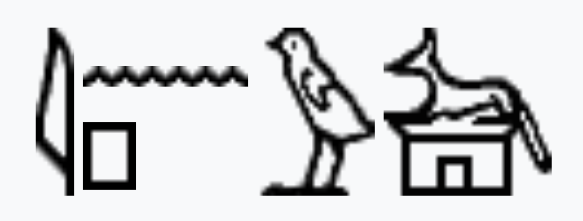
We are now getting funky with the determinatives, eh?
A dog. Cool, right? Something with dog.
Can you read this one?
Remember the cute quail chick as well-
Transliteration: inpw
And what about the reading? We’ll read the “w” as “u” out, as it covers the “u” vowel as well.
Reading: inpu
Who is Inpu?
Now… remember that I’ve mentioned something about the “Greek versions of the names”? I and A stuff? Yeah.
We can also read it as “anpu”. He is Anubis, deity of death and many things. With the canine head… that’s why the dog was here!
Great, isn’t it?
EXERCISE 6:

Now we are reading something real! Let’s go!
Facing right… Right-to-left…
Something unḪeard of.
A cute quail chick (uwu)
Horned viper that makes us go FUCKING SHIT
And another cute quail chick!
Ready?
Transliteration: ḫwfw
Reading: khufu
You know this man! Second pharaoh of the Fourth Dynasty… Think of the pyramid names you know… Cheops pyramid is one of the first ones you can think of, right? It’s him! He is known to Ancient Greeks as Cheops!
Khufu!
EXERCISE 7:
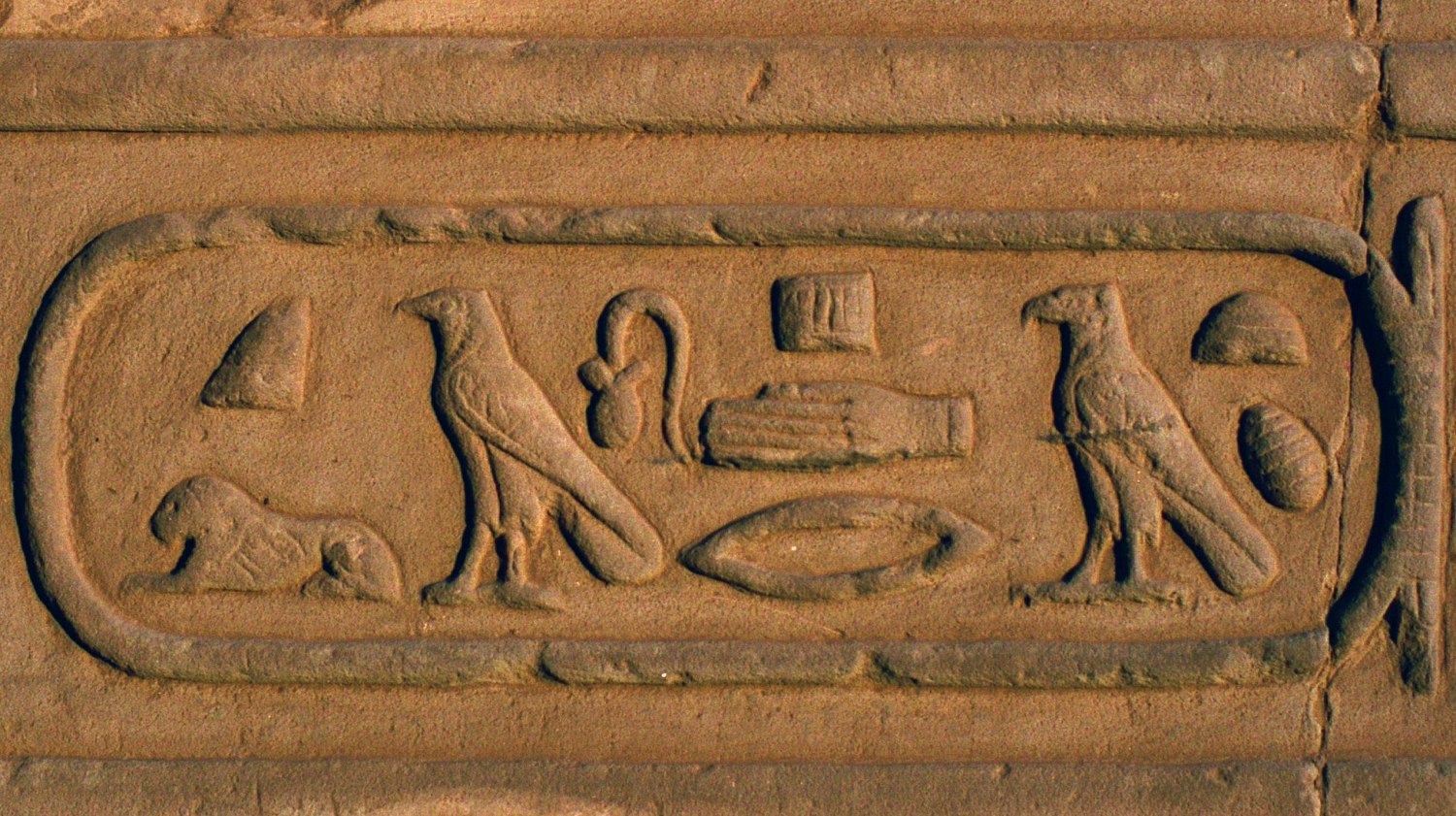
This is not tricky at all! Don’t worry, we have enough knowledge to read this. We will leave the last two symbols out as they are not a part of the name as phonetic values.
Left-to-right!
Hill? Jacq and Jill went up the hill…
Beware, Lion!
And we see a vulture…
That lasso, cord… Reminds me of Umbilical Artery…
A stool, you got this one!
Or maybe you need a hanD?
Reading this perfectly…
Another vulture!
Transliteration: ql3w3pdra
Reading: kleupadra
Kleopatra! Here we have our famous lady!
Congrats!
EXERCISE 8:
Remember this from the beginning?
Let’s fucking go!
Right-to-left. You got this.
Stool.
Loaf.
Lasso.
Lion.
Owl.
Two reeds.
Folded cloth.
Transliteration: ptwȝlmys
Reading: ptulmys (sprinkle some “e”s here and there and you are fine!)
Name any familiar?
Ptolemy, Ancient Egyptian version!
Nothing on the face of this earth could have made me sit down and explain the basics of a dead language at this hour, in this situation. But I am doing it anyway because you are amazing. And there is this thing… To quote Leopold von Ranke, as he explained the basic principles of history in the late nineteenth century, “The first demand is pure love of truth.” You are here because of pure love of truth and knowledge. I am here because of pure love of truth and knowledge. Imagine how happy the ancient humans would be if they heard about this… People reading about ancient hieroglyphs on a storytelling platform, just because they want to learn. They would feel proud. History is proud of you. I am proud of you. Be proud of yourself as well. This is honourable.
It is 3:50 AM right now and I am proud as fuck. You are amazing. Congratulations, great souls. You’ve done it.
Thank you so much for reading, thank you so much for everything!
Will be updating this depending on the amount of free time I have that I can do research and write shit on…
Have a wonderful day!