
Work Text:
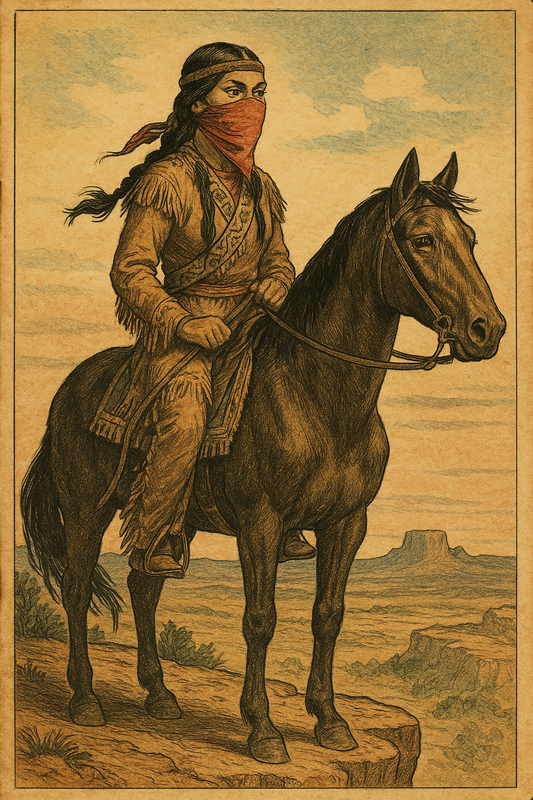
THE SAVAGE SISTERS OF THE SHADOW RIDGE
Printed 1874 in “Blood & Thunder: Tales of the War-Torn West,” and later reprinted under the title “The Outlaw Angel’s Last Ride,” though many believe it was hardly her last.
Being a truthful if startling account of the daring escapade of two outlaw women of the wilderness, whose bullets sang and whose steeds thundered like judgment down from the hills during that most trying of times—the War Between the States.
Transcribed from the recollections of one “Old Dan Harker,” a trapper and occasional whiskey merchant, and several unnamed Union scouts encountered near the Arkansas border. Printed at the offices of The Wide West Weekly.
There was a time, dear reader, when the night hills whispered more than wind and critters. When a man with wickedness in his heart would look over his shoulder long after sundown, and think twice before laying hand on musket or match. That time was the Year of our Lord, 1863, and the region was Missouri's southern edge, where the tall grass met dark woods, and railroad tracks split through holy hunting grounds like a knife through sinew.
It was then that they appeared—two women, fierce as mountain lions and silent as dusk. The locals called 'em all manner of names. Some said they were specters. Some called them The Blood Sisters. Others whispered “The Ghost Riders of Red Prairie.” Their true names are lost to history, but from scraps and stories, I shall call them Katana Jane and Little Tempest.
Jane, the elder, was said to be tall and proud, her long dark braid adorned with beads and brass buttons from bluecoat uniforms. Her rifle—a battered Springfield, sawed just so—had ended the careers of more than one Confederate sergeant, if the tavern tales hold true. Her younger companion, Tempest, was lithe as a fox and twice as quick, known to throw a blade as fast as she drew breath.
They rode together like thunderclouds crossing the plains. Their steeds were black and chestnut, and no man could match their speed, not even the devil's own cavalry.
The story told here begins with a Confederate outpost—a supply depot near a bend in the river, overseen by a certain Captain Wilkes, a man who claimed to be descended from George Washington himself. He had little patience and less honor. The depot guarded munitions, foodstuffs, and ill-gotten gains raided from local settlements and farmsteads.
Old Dan Harker, who swears upon his remaining teeth he saw it all, said the sisters scouted the place from atop Buzzard Hill, studying movements, counting guards, noting weaknesses like hawks eyeing the slow lamb in the herd.
Three nights later, the moon hung like a tarnished coin in the sky when they struck. First came the fire. Gunpowder they’d stolen from the very train meant to resupply the depot was repurposed and laid in kegs beneath the horses' troughs and hay barrels. With one spark—boom!—the barn went up in flames, and the chaos had begun.
Rebels ran out in underclothes and boots, half-awake and wholly panicked. That’s when the shots rang out. Jane, high on the ridge, fired methodically, each bullet finding a mark. Tempest—by then already within the camp—moved like smoke, slashing lantern ropes, flipping supply crates into the blaze, and cutting mule lines to spook the animals into further chaos.
Captain Wilkes, in his long red cloak, burst from his tent, barking orders and drawing his pistol. Witnesses swear Tempest faced him down, knife gleaming, but let him draw first.
“He got his shot,” one scout recounted later, “but she got hers faster.”
They left the camp in ruins, with nothing salvaged but shame. But more curious is what they didn’t take—gold, arms, even whiskey barrels were left behind. All they seized were the slave registers, which they burned publicly, and a trio of captives—Black men and women shackled in the rear of the storehouse—who rode away behind the sisters on stolen horses, bound for freedom beyond the Rio Grande.
Some accounts say the Confederate army set a bounty on their heads—five hundred dollars dead or alive, raised to a thousand after a second raid saw a rail bridge fall into the river. But no posse ever returned with proof. One marshal claimed to have seen their campfire once, but lost the trail by dawn. Another said he found bootprints leading into the mist and horse tracks that simply vanished.
As for Old Dan Harker, he swears on a prayer book that he once saw the pair up close. Claims they passed him on a stormy road, nodding curtly, Jane adjusting her bandolier, Tempest eating a raw turnip like it was a fresh apple. They didn’t speak, but their eyes, he said, were like flint and thunder—enough to quiet a bear.
Were they outlaws, or angels of vengeance? Ask any old-timer in those hills and they’ll say both. They had no flag, no home but the wild, no law but their own, and no master above or below.
And if you listen real close, as the wind winds across the hollow, you might still hear hoofbeats echoing through time, the legacy of two women who would not bend, could not be bought, and left their mark on the soul of the frontier.
THE OUTLAW ANGEL RIDES AGAIN
Featuring the unparalleled marksmanship and iron nerve of the wilderness rebel known only as Katana Jane, as witnessed by stunned men and sung of in low voices by those who feared and admired her both.
Among the many yarns spun along the rail lines and riverboats of the Missouri Territory, few tales travel farther or faster than that of Katana Jane’s legendary reverse gallop. And yes, dear reader, I shall endeavor to tell it true—though truth, like a rifle in Jane’s hands, is subject to aim.
This happened sometime in the summer of ’64, as best as can be traced, during the peak of the Confederacy’s desperation and when many small patrols became more bandit than soldier. One such outfit—a ragged band of conscripts turned marauders—had taken to calling themselves “The Bone Spurs.” Led by a former dentist turned lieutenant, Cornelius Mott, they plundered what they pleased, from livestock to letters of safety, and called it service to Dixie.
The Bone Spurs rolled into a creek village on the edge of Red Ridge, demanding tribute from homesteaders and threatening reprisals if their commands weren’t obeyed. The people there—freedmen, settlers, and a few old Shawnee families—had little to give, but Mott and his boys were not men to be reasoned with.
Unbeknownst to them, a message had been carried by mule—and by midnight of the second day, the sisters rode in.
The ambush was swift. Chenoa—Little Tempest—handled the dynamite, placing it behind a smokehouse where the Spurs had corralled their horses. She lit the fuse with her knife-tip dipped in pine tar and flame.
But it was Jane who rode into town—not out—from the far tree line, astride her black mare like a Valkyrie born of thunder. She came not forward but backward, seated astride the saddle the wrong way ‘round, facing behind, reins looped around her boots and rifle raised.
A witness—an old preacher named Elias who’d come west to find salvation in the soil—recalled, “She was ridin’ backward like it were nothin’ more unnatural than breathin’. And them Bone Spurs? Well, they never even got off a shot.”
They were ten men, armed with carbines, flintlocks, and pistols—some fancy, some borrowed. Jane rode through like a wraith, knees gripping her mount, arms steady, firing as if her soul had been stitched to gunpowder and grace.
The first bullet snapped the revolver clean from one man’s hand, spinning it into the dirt. The second shot took the hammer off a rifle, the third the barrel clean in two.
“Hellfire!” someone screamed.
By then, panic set in. The Spurs stumbled over one another trying to draw or duck. Jane didn’t yell. She didn’t sneer. She smiled—according to Elias—a calm, cold grin that made the hair on the back of your neck whisper scripture.
Mott, the dentist-turned-scourge, finally leveled his weapon and bellowed for her to halt. But Jane, never ceasing her backward gallop, twirled her rifle like a baton and with one calm squeeze shot the buckle from his belt. His trousers dropped and so did his nerve. He sat down right there in the dust.
The explosion from Chenoa’s fuse split the night. The Spurs’ horses, frantic, broke free and scattered into the brush. In the confusion, Jane and Chenoa corralled the Spurs—now weaponless, pantsless, and shame-drunk—into the town square.
And that, dear reader, is when the true punishment came.
Jane dismounted, still facing backward, dropped the reins and stepped into the circle of shame. She spoke just once.
“You come here again,” she said in her calm, strange cadence, “and I’ll ride backwards through your dreams, not just your camp.”
Then she turned and walked forward, for the first time that night, rifle slung casually over her shoulder.
Elias later described the crowd as “stunned, reverent, like folks after a good sermon or a lightning strike. Nobody clapped. Nobody dared.”
The Spurs were marched off in disgrace—stripped of weapons and pride—and told to walk until their feet bled. Some say they never stopped walking.
The tale grew, as such things do.
Some said she could shoot a coin from a crow’s beak at two hundred yards. Others claimed she could read bullet trajectories like a gambler reads cards. One story—possibly apocryphal—claims a soldier tossed his pistol into the air in surrender, and she shot it twice before it hit the ground, shattering it to splinters mid-air.
What is known is this: no train, no trooper, no bounty ever caught her. And when the sun sets just right across the back trails of Arkansas, you might still hear hoofbeats where no road lies, and catch the glint of brass buttons on the wind.
And if the rider’s turned backward?
Well, best you keep your hands where she can see them.