
Work Text:
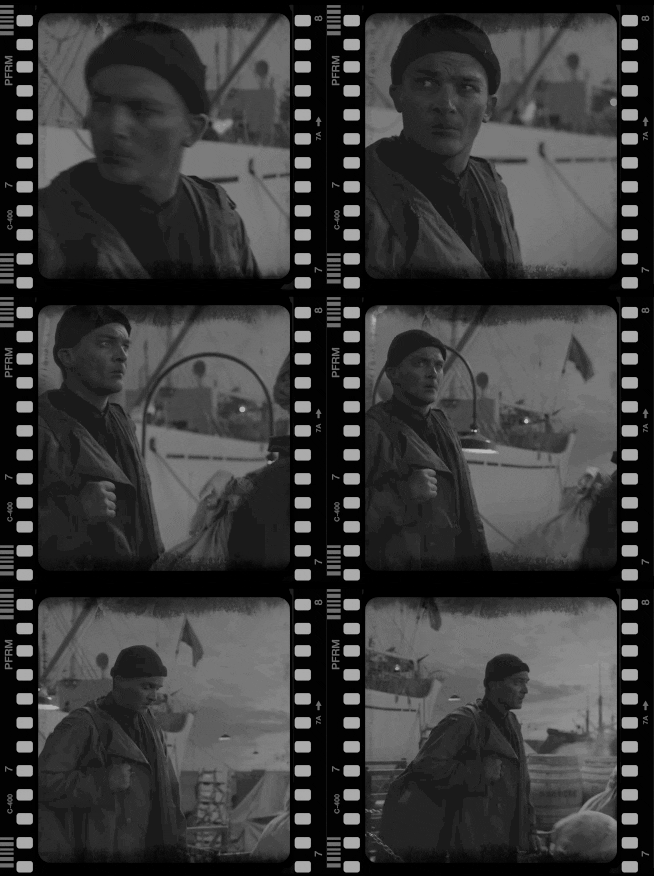

In order to be found, you must first be lost, and the Great Beast knows in his heart of hearts that I am the Prince of the Lost.
I lean over the pockmarked railing. It has peeled and been repainted so many times, there are basins and islands and continents of paint that rise and sink across its rough surface. The night is warm. The ocean is black. The sky is black. There are neither clouds nor moon, only stars. Where the sky meets the water is as obscured as where my past meets my present.
I opened my soul to Jack Parsons, as instructed, and for a moment, he seemed to look within the glowing space in my chest and take notice. But only for a moment. And yet, that moment scoured me with a wind out of the desert carrying vicious sand, with a hurricane making landfall, with implacable questions about my nature and why I am here. I ain’t got nothing against queer folk. I take it that my demeanor isn’t one that attracts them, so the few times it’s been clear to me that I was in queer company, whatever mythological ills and lewd pawing I had been assured would happen, they did not happen, neither out in the wilds of Los Angeles or within the safe arms of the Agape.
Maggie laughed prettily when I made casual mention of the fact. She said, “Oh, hun. If all the queers up and vamoosed from Hollywood, I’d be clean out of a job. And rough and tumble as you look, they wouldn’t dare. Ninety percent of getting your face on screen is just having a pretty face.”
She pretended to fix my collar, took a sip of her martini, and walked outside. It was her quiet way of letting me know the matter had discomforted her. I did not know why then, though I do now.
The man at Maxwell’s who I’d mistaken for Jack, the one with the pencil mustache and flamboyant shirt, the one who’d taken a risk, the kind of risk any man would recognize, the same risk I had taken standing on the street looking into the soft glow of the windows that hid a secret world inside - speaking to that man had been a revelation. A man knows another man’s game without need of explanation - queer or not - and when I saw him take me off the menu, yet still wish to continue the conversation, it was a new thing, a new experience. I was both relieved that he was so easy with his words and confessions, like I was a priest in a mahogany box behind a brass grill, and also suffocated at the fact that it was a stranger, and not my Jack.
Jack, who swam with me in the cold ocean where we laughed as though we were boys, the only boys in the whole of the world.
Jack, who snored softly in the car as I drove, his face relaxing into angelic beauty.
Jack, who howled into the sun like Icarus from the seat of a crop-duster.
I have imagined Jack professing his love to me. I have seen it so many ways, in so many words. At the Agape in the cloying warmth of the attic, in my living room with the sun setting behind the hills, leaning beneath the hood and across the exposed entrails of the Chevy’s six-cylinder stovebolt, hands black with grease and wrenches, as men are wont to do. I have embraced him clumsily in my mind. I have brushed my lips against his. I have repeated his words of love and felt them slide into positions within my soul that locked me to him, making us into one person.
But the man with the pencil mustache and flamboyant shirt was not Jack, and I would have to be content that the conversation had ever happened at all.
Until the fuzz showed up.
Few things are as dangerous as a man who is dead-sure of his righteousness in the face of something about which he knows not one damned thing.
In he strolled, hands at his hips in order to flash the firearms that were also there, his wide paunch so resplendently displayed, you’d think it were a strong-man’s chest.
He knew where he was - we all did - and the way he rolled in, it was like he owned us. He was the master and this was his plantation.
I doubt very much that it was his pleasure to have a number of his teeth knocked loose by yours truly. And I must report that another lie made itself known that night. Pencil Mustache threw several respectable punches that landed quite squarely. He defended himself admirably before the clubs came out.
Maggie had to bail me out.
Maggie had to listen to the officer at the desk explain the charges, explain where I’d been, with whom I’d been.
Maggie had to suffer one last humiliation because of me.
I would say “one more humiliation”, but it was the last one on my account. The last of a rather long list. She packed up the Chevy and disappeared into the hills of California. No fanfare, no melodrama for the neighborhood to morbidly enjoy, none of that, which is how I knew it was really the end.
Her star became a comet against the night sky - beautiful, fierce, actinic, and gone. I do pray she finds her will, and under that, her love. She is infinitely more worthy than I.
What do you do when the tapestry of your life has come to a thread that’s too short to weave? I can’t answer for everyone, just myself. Forever branded as the worst kind of deviant in the eyes of sidewalk swells and dandies, I did what many penniless men did in those days. I signed a contract, shed my skin, and boarded a ship as a merchant sailor.
And here I feel I must disabuse you of any preconceived notions concerning life aboard a merchant ship. Put away your fantasies of high-seas adventure. Whether she is under way or at port, there is no end of work on a merchant ship. There is no space. There is no privacy. There are no cabins - not on this ship, not for us - only a wall of bunks like coffins with a curtain to one side. Could be better, could be worse. I’m told that some larger ships do have the luxury of tiny cabins for sailors with seniority, but smaller vessels have fewer bunks than men and hot-bunking is the norm. The other sailors come from every corner of the globe. Those who speak French, both white and colored, tend to form one group, though it divides when the colored men pray to Mecca. The Chinamen keep to themselves. The Mexicans are oddly comfortable crossing lines, picking up bits of lingo here and there, making bawdy jokes with the Portuguese men who pretend to understand them better than they do, and the Brazilians who understand them perfectly. They have a special relationship with the few Filipino sailors with whom they share blood. The white men, the Americans who only speak English, they are the most isolated on the ship, though English is the understood lingua franca. They do not coalesce like the other men, and I think perhaps they too have shed their skins like me and still feel too close to home to enjoy their new ones. The American captain and senior crew treat the rest with professional disdain, oblivious to the fact that the disdain is reciprocated ten-fold. The poor Spanish I learned on the trail from Oklahoma to California has proven to be a significant boon. A few hesitant attempts to communicate with the Mexicans in their own tongue, to trade cigarettes for liquor, earned me new friends willing to teach me more.
“Why’d you come to the U.S? Why don’t you sail from Mexico,” I once asked Julio, a sailor who says he enjoys the company of my silence.
“Los Angeles was Mexico, pendejo. My family has been there longer than we can remember. We didn’t go there. We’ve always been there,” Julio answered.
And I learned that disdain is often the other side of shame, born of ignorance, because while I had known that fact, I had never thought of its implications, the ones with which Julio dealt every day of his life, a man made from the very soil of California, yet forever seen as a foreigner.
Julio is intent on befriending me. He invites me to play cards and dominoes, the favorite game of those who speak Spanish. He teaches me the strategy and how to play as a team. It’s pretty much like cards, ‘cept a domino tile hurts quite a bit more than a card when flung in your direction, which has a habit of happening as the night goes on.
The other night, standing right here next to me at this railing, passing a shared cigarette back to me, he said, “Sometimes men jump,” and then held my eyes longer than men dare, waiting for the meaning to sink in. He was worried for me. I passed the cigarette and just smiled.
“You ever been to Puerto Rico?” he asked. It’s our next stop.
“My first time on a ship,” I answered, but he’s known that for some time.
“Spanish girls - the prettiest girls in the world,” he continued, talking at the water. “But the Puerto Rican girls - you ain’t never seen nothin till you seen a Puerto Rican girl. Just you wait,” he says because there have been ports down the west coast of Mexico and then the canal, and now we’re in the gulf, but there have been no girls. I have borrowed no money to pay for their pleasure. I have asked no one where one can find easy company at the port. I have done none of that, and Julio, in his strange, warm, brotherly way, had taken notice.
“Maybe,” I said in deflection.
The crew chief came by and ran us off back to work.
I don’t see them tonight, either the crew chief or Julio. The wee hours are upon us and sleep was nowhere to be found. Orion, whose father was Poseidon, is high in the sky. I contemplate his shape. If every man and every woman is a star, as the book says, then are we not also constellations? Do we not have coordinates and positions with respect to one another. Who has Julio become in the constellation that includes me? I am in retrograde, I think, retracing a small spiral in the sky, taking a step back before moving forward.
What sky is Jack looking at tonight, if at all? What rockets is he putting into the firmament? What planets is he conquering? Which Martian princesses have fallen for his devilish charms, and which have resisted?
I am a man. I am a star. I am a compass, and my needle still points relentlessly toward Jack.
The Port of Ponce is our destination. We load coffee onto the ship. Julio illuminates that when Puerto Rico belonged to Spain, her coffee was famous around the world. Under an American hand, the island had leaned more heavily into sugar. Our ship isn’t remotely up to the mighty task of Puerto Rican sugar, but we can handle the remains of her coffee production. I ain’t got too many skills that are of particular use aboard a ship, but life has given me a strong back and rough hands. There is a peace to be found in that kind of labor, a path that opens up and lets you get out of your head and into your hands. The ship brings the coffee in by crane on palettes from the dock, but once in the hold, we have to distribute the fifty pound bags.
The perfume of coffee is wild; it gets into your bones.
I work two shifts and am refused a third.
Julio is at the curtain to my bunk.
“Come on, man. Lets get a beer. I know a place,” he says. There is supplication in his voice, and I realize I have been callous with my friend. I have not valued his concern for me.
I pull back the curtain and say, “Okay, let’s go.”
We walk past the huge warehouses and there are a few cars parked, men casually conversing near them. Julio approaches them, gestures off into the distance and then waves me over.
“Come on, we got a cab,” he says.
I look at the old Studebaker and say, “Don’t look like a taxi to me.”
“Relax, man. It’s Puerto Rico. It’s a carro público. Public car.”
The driver and Julio converse animatedly the whole way. They make a game of how quickly one topic loops off into the next. I understand most of what the driver says, but the cadence and the rhythm is from a different song entirely to the one Julio uses. The words are clipped in odd ways and I get the impression that if this man where to lose a hand for some reason, it would be the same as losing his tongue. It’s mesmerizing to watch. I do not mind that I am the oft-mentioned gringo. Julio tells him I understand, but the man’s eyes in the rearview are incredulous.
“El español suyo es muy diferente al que habla mi amigo,” I say. My accent’s never gonna be more than a badly tuned banjo, but I think I said it right.
His shoulders bounce in restrained laughter.
“You hear the difference?” he asks in perfect English.
“Yeah, I hear it,” I say to his reflection.
“Most gringos can’t hear shit.” Then to Julio, “You teach him?”
Julio nods enthusiastically.
We hug the coast. The air is ripe with smells. The coffee impregnated in my skin, the iodine of the water, and a sharp loamy smell when the wind comes in from the forest. It’s near dark, but still I see the violent green of a jungle that is eternally offended at the presence of the road, determined to take it back at all cost. The palms may be the same as in Los Angeles, but that’s where it ends.
I lean into Julio’s shoulder and ask, “Where are we going?”
“El Mondongo,” he answers.
I don’t know those words.
“Girls,” he says more quietly in English.
It turns out to be a little shack that appears to have been constructed of found materials. You see them in many places in Latin America, the local sentiment typically being that if the place looks too fancy, it’s not any good. Bare bulbs strung on bare cords light the place garishly. Julio pays the driver and waves away my offer to pitch in. The driver, surprisingly, enters with us. It’s mostly an outside affair. Men with beers in hand give me the once over suspiciously. It’s the driver who returns with the first round of beers. I thank him profusely and seem to embarrass him.
Behind the little shack with windows and doors that lock with plain wooden beams, there is a deck, behind the deck a solid wall of rock rises. A Wurlitzer inside plays music. There are women dancing with the men, and it all looks rather more formal than one would expect.
Julio turns to me. “If a girl talks to you, talk to her. It’s okay. But keep it easy and only small talk. Don’t be grabby. If she asks you to go for a walk, well… You know. But don’t be stupid. The owner has a shotgun and no one's gonna look for a lost gringo. Okay?
Some stories are the same no matter the country, no matter the language.
I find a corner into which I can tuck to pour back the beer and not be noticed.
A girl with glossy curls and a big smile is talking to Julio. She is a confection of Europe, Africa, and the faces of Indians I have known out west. She is shaped like a guitar. Julio is right. The women are beautiful and friendly. The formality is just a game, but an important game. This can only happen in the open if it looks like something else. I remember Pencil Mustache at Maxwell’s.
There is a young man sitting near me, looking into the crowd just as I am.
“No hay que ser tímido,” he says. He gestures at the women with the tip of his beer bottle.
“No.. no estoy… I’m not scared,” I stammer.
His face instantly transforms. Like the beauty dancing with Julio, he is many things at once, dressed in a loose white shirt, matching slacks and a fedora. Thin as a rail, olive-skinned, and what I could see of his hair was groomed to a tight, razor perfection. His eyes are as green as the foliage that threatens to consume the little establishment.
“You from New York?” he asks, sliding his chair over to my tiny table.
“No,” I say. “California.”
“I’m going to New York,” he advises. “Quiero ser músico.” He wished to be a musician.
“What do you sing?” I ask, his youthful energy drawing me in.
“Bolero,” he says as if any other answer would do. “Soy Miguel Ángel.”
“Ernest,” I reply, having never noticed how cramped and tight my name sounds until sat next to the liquid flow of the young man’s name. “You any good?”
“I hope so,” and the comic mug he adopts makes me laugh.
A few more beers go by. He gets them all from the tiny bar, but doesn’t refuse my money when I slide it over. I have learned all the gossip there is to know about those gathered here. I know that man over there regularly wakes up drunk under his house and that the woman over there sells illicit drugs. My curiosity is momentarily piqued, but I can see what my new friend thinks of drugs and I squelch the idea. I learn who is secretly broke and who is secretly rich. I know who has children about which they themselves know nothing.
And then it happens.
“Estoy jumo,” says Miguel Ángel. I don’t know what that means. “It’s hot. Let’s go for a walk.”
I do know what that means.
He gets up before he’s even finished the question.
I follow. I don’t know why, but I do. I don’t see Julio anywhere. Miguel assures me there will be cars to take me back to the port.
We roll down to the main drag that runs in front of the place and walk the shoulder for a bit. Without the music, the high-pitched chirping from the dark foliage fills the night.
“What kind of birds are those?” I ask, gesturing vaguely into the dark.
“Frogs. Coquí frogs. We love them because they are like us, small but loud.” His smile is ghostly in the dark beneath his fedora and above his shirt.
He turns onto a small road that climbs upward. The smell of loam I noticed earlier becomes powerful, rich, alive. Tiny houses on stilts line the tight, winding path. The lights are out in most of them and the few that are lit have the glow of oil lamps. I don’t see any power lines.
Miguel gently takes the inside of my arm, but only to guide me to what I assume is his place. It’s as small and rough as the rest. We go inside and he lights several lamps. It smells of wood and dampness inside.
I am afraid. I don’t know why I am here, or I do and I don’t want to admit it.
He must have taken notice and says, “Tranquilo, compai.”
He reaches into a doorless closet and takes out an instrument that looks like a guitar but isn’t. He gestures with his chin to a chair on the porch near the front door and I sit in a tight little knot.
He sits in another chair on the porch, rests the instrument in is lap, closes his eyes, and begins to play.
Tú tienes todas las cosas
que Dios hizo lindas en una mujer.
El pelo, los ojos, la boca.
Y ese cuerpecito de pura Raquel.
Tú eres más linda que Adriana.
Y mas que Jean Harlow y mas que Mae West.
Y más que todas mis novias.
Y más que las novias que tuvo Gardel…*
The instrument has the subtle burr expected from doubled-course stringing, as sweet, rich, and surprising as a ripe orange. It is nothing compared to his voice, gilded with talent, honeyed with youth. His vibrato is crystalline. It is a love song, a gift of devotion to a woman described as a goddess.
Is it any wonder that passion and romance are the hallmarks of his culture and people?
“That was beautiful,” I say when he comes to the end, and my words feel so ugly and base compared to what has just happened.
He looks up into the night sky. “El cazador,” he says, pointing up.
I follow his hand. “Orion, the hunter,” I confirm.
He puts the instrument down with all the care of a beloved treasure, and with as much grace as he can muster, brings his chair closer to mine.
“The only sin is to lie about who you are,” he says, and it is a hot knife into my chest. Do as thou wilt shall be the whole of the law. He said it differently, but it’s the same.
His warm hand slips across the back of mine, his fingertips wrap under my palm. “What do you hunt for?”
“I.. I can’t…”
“It’s okay. I know,” he says. “There is someone else. I see him there, behind your eyes. Does he know?”
My heart is racing. He says what he says with a confidence that is alien to me. My mouth is devoid of spit, dry as a bone. My vision closes in a bit before I say, “I don’t think he does.”
And a mountain is removed from my chest. The sea empties from my lungs. I breathe like a man running a marathon.
I look up again at Orion and clarity smacks me in the face. The Great Beast has been with me all along. He is the ship. He is Julio. He is the pretty girl with glossy curls. He is Miguel and his angelic voice. He is Orion the hunter.
I have not been abandoned. I have not been forgotten. I am being shown. I am being educated. I have been cherished and as blind to it as a petulant child.
I pull Miguel to me, my hand cupping the side of his head and kiss him gently, but fully. Not a chaste kiss. A lover’s kiss.
The sky is black. The forest is dark.
But I am not alone.