
Chapter Text
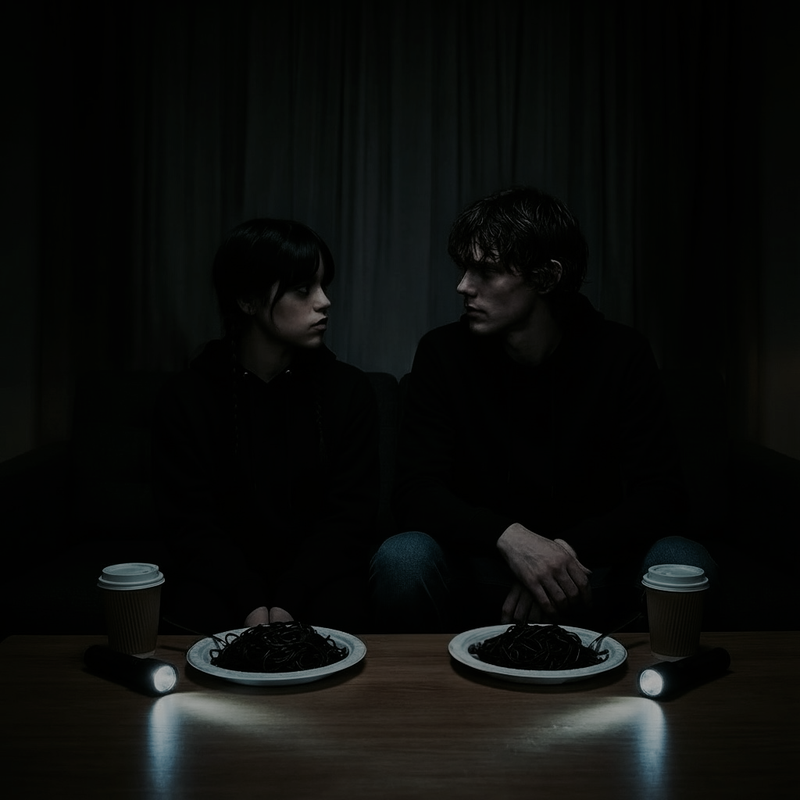
POV Wednesday
The newspaper disappointed me again.
I was sitting in the library at my usual table by the window, where the light looked washed‑out, like an old photograph. A fresh paper lay on the desk, still smelling of printer’s ink and already hopelessly outdated in my eyes. I turned the pages methodically, the way I would open up a corpse: in order, without emotion, but with the expectation of something interesting beneath the first layer.
Nothing.
Not a word about Burlington. No follow‑up to that short piece that had caught my attention a few days ago. No victim’s name. No address. Not even a pathetic attempt by some journalist to pass gossip off as fact. A void. The paper was full of life—but not the kind I cared about. Politics, sports, weather forecasts, advice on “finding harmony with yourself.” As if anyone seriously believed you should make peace with yourself instead of using yourself.
I went back to the crime section. In the earlier piece there had at least been something: “a man,” “the suburbs of Burlington,” “strange circumstances.” Now—silence. As if the very fact of the murder had been an unfortunate typo the editors had decided to quietly erase.
“Burlington suburb” was a phrase worthy of separate contempt. It was like saying “somewhere on Earth.” Theoretically accurate. Practically useless. I could build a mental map: single‑family homes, narrow streets, scattered streetlights. But without a point on it, it remained an abstraction. A ghost you couldn’t catch.
I hated being deprived of specifics. The world was already full of chaos. People tried to sand it down by inventing laws, rules, routines. I dissected it to see how everything was put together. When no one gave me a single lead, it felt like mockery: setting a patient in front of a surgeon and refusing to hand over a scalpel.
The paper crackled in my hands. For a moment I imagined I was crushing not newsprint, but the throat of the editor who’d decided “details not being disclosed” counted as an answer. Then again, he was just a reflection of the system as a whole: the police preferred silence whenever they didn’t understand what they were dealing with. Or when they understood it all too well.
I could have accepted not being called to the scene. I was not going to accept being cut off from information altogether. It wasn’t just professional offense. It felt like being stripped of my right to be useful. And dangerous.
Suddenly a shadow fell across the paper. Someone had blocked the light.
“If you stare at it like that for one more second, it’s going to catch fire,” Tyler’s voice said above me.
I looked up.
He stood opposite the table in his school uniform, hair in its usual disarray, wearing that cautious half‑smile he seemed to think could neutralize my personality. The light from the window cut diagonally across his face, leaving half of it in shadow. Fitting.
“You’re blocking my text,” I said. “Move, before I use you as a stand for an obituary.”
“Judging by your expression, somebody’s going to need one soon anyway,” he said, sitting down across from me without asking. “Why are you so mad? Even by your… grim standards.”
I folded the paper in half, but didn’t put it away.
“Because the world has disappointed me again,” I said. “Though you’d think it had nowhere left to fall.”
He tilted his head.
“More specifically?”
I sighed. Explaining the obvious always struck me as a waste of time. Unfortunately, most people were born without brains, not with them.
“A few days ago,” I began, “there was a murder in Burlington. The paper wrote: a man, the suburbs, ‘strange circumstances.’ No name, no address, no details. I waited for today’s issue to get at least something useful.”
I tapped my finger against the news header.
“The result: nothing. As if there’d been no murder at all.”
“Maybe the investigation’s sealed?” he suggested. “You know, interests of the investigation and all that.”
“The phrase ‘interests of the investigation’ usually covers the absence of an investigation,” I cut in. “If they’d at least named the street, I could have…”
I broke off. Admitting out loud that I’d already been mapping routes to the crime scene felt needlessly revealing even for me.
“Could have what?” he prompted.
“Done the job the police are supposed to be doing,” I said dryly. “But without basic data, that’s… problematic.”
He watched me for a moment, then the corners of his mouth twitched.
“So you’re not angry about the murder, you’re angry they’re not letting you near it?”
“I get angry when they take away my ability to work,” I corrected. “Murders are a constant. My involvement is the variable.”
He gave a short laugh.
“You’re trying to get mixed up in another case.”
“Cases get mixed up in me,” I countered. “I just don’t step aside.”
He leaned back in his chair, studying me like he was trying to decide how deep I was already buried in this one.
“All right,” Tyler said. “When you get even the smallest lead, I’ll help. However I can.”
“You’ve ‘helped’ before,” I reminded him. “The result was blood, murder, and betrayal.”
He held my gaze.
“This time I’m on your side, Wednesday,” he said quietly. “And I remember. Everywhere I went, she was there too. Now she isn’t.”
I peered at him, looking for falseness. Lies. Evasion. But all I saw was the same familiar guilt and a stubborn decision not to run.
Irritating.
“We’ll see,” I said, unfolding the paper again. “For now I don’t even have an address for the corpse. So your help is theoretical. Like the competence of the police.”
A couple of days later, Tyler and I were in chemistry together.
Mr. Kim was droning on about valence electrons; the classroom smelled of alcohol, dust, and other people’s fear of the upcoming test. Formulas appeared on the board like failed spells. I copied them down automatically, but my thoughts weren’t in the room.
They were in Burlington.
I kept replaying that pathetic paragraph from the first article: a man, the suburbs, strange circumstances. No updates in two days. Not in the local papers, not in the general news roundups. As if someone were deliberately keeping the case in the shadows. Or drowning it.
I was so deep in my thoughts I didn’t notice at first when a notebook slid up to the edge of my desk.
I glanced sideways. On the page, between formulas, in neat handwriting:
“How about dinner tonight?”
I raised my eyes. Tyler was pretending to listen intently to Mr. Kim, but the corner of his mouth was twitching. He held his pen poised over his own notebook like he was ready for a second strike.
I took my pen and wrote beneath his question:
“I’m not in the mood. Or hungry.”
The notebook went back to him. He read it, smiled faintly, and immediately added below:
“All the more reason to go. You need a distraction. And I have a surprise.”
I didn’t like surprises. They usually came with nothing but disappointment or boredom. Sometimes both.
I hesitated, then wrote:
“I don’t like surprises. Or people who think they know what I need.”
He read that, tilted his head, and, without looking at me, quickly scribbled:
“But I’m insisting anyway. 11 p.m. Nevermore gates.
Wear something with a hood.”
I stared at the last line. A hood?
Something inside me gave the faintest twitch. Interest. A dangerous, but honest, emotion.
I exhaled heavily and wrote:
“If this turns out to be a moonlit marshmallow picnic, you’re a dead man.”
He read it, this time allowing himself a full smile, and added:
“Perfect. Then at least we’ll have a corpse.”
I handed the notebook back and pretended to sink into the formulas again. In reality I was already counting down the minutes to lights‑out and trying to decide what annoyed me more: his persistence or my own agreement.
By the appointed time I was more ready to walk out of my skin than out of the room.
I stood by the wardrobe, pulling on a black hoodie with a hood. Since I had no idea where Tyler was taking me, I was also wearing comfortable black jeans and sneakers.
“Where are you going?” Enid’s voice sounded far too innocent to be safe.
I turned. She was sitting on her bed hugging a pillow, watching me with the kind of glow in her eyes people usually reserved for prom nights.
“For a walk,” I said. “Moonlight has a beneficial effect on my nervous system. And a harmful one on anyone who tries to stop me.”
“After curfew?” Her eyes went wide. “Breaking the rules… again.”
“Does that surprise you?”
“Not in the slightest,” Enid beamed. “You going alone? Want to take Thing? He loves night walks too.”
She glanced at the hand sitting on her windowsill pretending to admire the moon. His fingers twitched suspiciously.
“Not this time. I want to be alone,” I cut her off. “But I’ll be back soon. And if I’m not—don’t touch my things. Especially the sharp, poisonous, or cursed ones. In other words, almost all of them.”
“We won’t touch anything,” Enid promised a little too quickly. “Cross my heart.”
She and Thing exchanged a look. He nodded energetically.
That was odd. Normally the werewolf pounced on any chance to conduct an interrogation with enhanced enthusiasm. Now there were no attempts to tag along, no extra questions.
“If you’re planning something with my things,” I said coolly, “I’ll get to yours.”
“Just go,” Enid only smiled. “You’ve got a walk… with yourself.”
She put so much rainbow‑colored expectation into that word it was unsettling. But there was no time to pick apart my roommate’s strange behavior. I pulled up my hood and walked out.
Tyler was waiting by the gates. Black hoodie, hood up, blue jeans. A big backpack hung from his shoulder, clearly stuffed with something other than textbooks. He looked like he was heading either to a robbery or to a jailbreak. Both options met with my approval.
“You look like a criminal,” I said as I came closer. “Promising.”
“Glad to meet your standards,” he smirked. “Ready?”
“To be ready, I need to know for what,” I reminded him.
Just then a car rolled up to the gates. A regular taxi. Far too regular for Nevermore.
Tyler opened the back door and leaned aside.
“Get in,” he said. “I promise it’s not the woods and not marshmallows.”
“If this is a romantic cemetery picnic,” I warned, “remember: there are plenty of empty plots.”
“You overestimate how banal I am,” he replied. “Now get in. We’re on a schedule.”
I got in. He followed. The taxi pulled away, leaving Nevermore and its towers shrinking in the rear‑view mirror.
“About forty, fifty minutes,” Galpin said. “So you’ve got time to decide exactly how you’ll kill me if you don’t like the surprise.”
I just snorted.
He steered the conversation toward Nevermore. The latest oddities, new rumors, Enid’s upcoming trip to camp. I answered briefly, watching him more than the road. Tyler spoke calmly, joked now and then. But there was still a shadow in his voice, like an old scar. It hadn’t gone anywhere, it had just become part of him.
After about fifty minutes, the car turned off into a quiet suburb. One‑story houses, sparse streetlights, dark windows. The taxi pulled up to the curb.
“We’re here,” the driver said.
We got out. The night air was damp and cool. I looked around. A row of identical houses. Nothing remarkable. At first glance.
“Where are we?” I asked.
Tyler smiled in that infuriatingly mysterious way.
“On our second date,” he said.
“The first one doesn’t count,” I reminded him. “That was a cover operation. You distracted me so Laurel could find Faulkner’s diary.”
His face darkened, but he didn’t look away.
“Yeah,” the Hyde nodded. “Back then I really did need you gone. But I also really wanted to spend time with you. I just combined business with… pleasure.”
He tightened his grip on the backpack strap.
“And I didn’t know what Laurel was going to do to Thing. I swear. If I had—”
“You still wouldn’t have done anything,” I finished. “You were under her influence. That’s not an excuse, but it’s not a death sentence either.”
He exhaled.
“But either way,” I went on, “the crypt date was interesting. And you really did surprise me.”
“Then I hope I can do at least as well tonight,” Tyler said with a slight smile.
We walked another couple hundred meters. And then I saw it.
A house. An ordinary one‑story house with peeling paint, dark windows and… yellow police tape draped across the yard like a careless shroud.
I stopped.
Something clicked in my chest. The puzzle piece finally slid into place: suburb. Private house. Tape. Burlington.
“You’re kidding,” I whispered.
I looked at Tyler. He was watching me closely, almost warily, like he was waiting for a verdict.
“This is it,” he said. “The crime scene. The one. The one no one’s written a word about.”
He stepped up to the tape, lifted it carefully, and looked at me.
“Well, Addams,” he said. “Shall we go in?”
The yellow tape brushed my shoulder like a lazy warning. I stepped over the line. Tyler followed.
At the door he didn’t bother being delicate. A couple of seconds to check the lock, and he slammed his shoulder into it. The wood cracked hoarsely and gave.
“There’s still a monster living in you,” I observed.
“Only when it’s useful,” he shot back, and let me go first.
Inside, it was dark and damp. The air was stale, like in a long‑sealed tomb. It smelled of dust, damp, and a faint metallic tang.
Blood.
“Pity I didn’t bring a flashlight,” I said.
“I planned for that,” Tyler replied.
He shrugged off the backpack, pulled out two flashlights, and handed one to me. I switched it on; the beam cut through the dark.
I looked at Galpin. At the flashlights. At the yellow tape hanging in the doorway. And before my brain could interfere, I grabbed his hoodie and pulled him toward me, kissing him quickly. Short, sharp, like signing off on a successful deal.
“That’s for the surprise,” I said, pulling back, then turned toward the hallway. “Let’s go.”
We started in the living room. The flashlight beam picked out furniture, books, photographs. Everything looked ordinary to the point of tedium. The man in the photos—the same one the paper had mentioned. Middle‑aged, average‑looking, standard gestures. Fishing, barbecues, a mug on the porch. Sometimes with people, more often alone. No wedding photos. No children. No sign of a vibrant social life. Lonely. Predictable. Boring. Exactly the kind of person neighbors usually describe as “such a nice man” and coworkers as “never would have guessed.” They live quietly, die suddenly, and turn into statistics with alarming speed.
I flipped through the victim’s photo album and thought his life had probably been filled with small rituals: work, dinner, TV, sleep. Maybe friends on weekends. Nothing that screamed “kill me.” But someone had come anyway. And done it.
The bedroom and bathroom yielded nothing. Everything was too tidy. Too clean. Too closed. No notes. No strange items. No hint of a double life. If he had one, it wasn’t here.
The kitchen changed everything.
The moment we crossed the threshold, it was obvious this was where it had happened. Blood on the floor, on the table legs, on the walls. There were droplets on the refrigerator door, as if someone had tried to grab it while falling.
I swept the beam slowly around the room. Sink. Table. An empty wooden knife block.
“The murder weapon was taken from here, apparently,” I said. “And carried away. Either by the police. Or the killer.”
I walked over to the doorframe and touched it automatically with my fingers.
The world lurched.
The kitchen stayed the same, but different. Brighter. Warmer. There was water in the sink. A plate in it. The man stood with his back to me in a faded T‑shirt, washing dishes.
I watched him and, at the same time, felt that my hands weren’t my own.
The skin wasn’t mine. The movements—someone else’s. A little heavier, a little sharper.
He was humming something. Then came a sound: a faint creak, a footstep, a scrape. The man flinched, turned, and looked straight at me.
If my visions had always been like a movie (I was the viewer. They were the actors), this time the victim saw me.
“You?” he said, frowning. “How did you get in here?”
His voice held surprise. Annoyance. But not fear. He knew the person whose body I was in.
And then I understood. I was seeing through his eyes. Through the killer’s eyes.
A hand—not mine—reached to the right. To the knife block. Fingers closed around a handle. The weight in my palm was familiar. Comfortable. I stepped forward. Or rather, the body I was trapped in did.
The man’s frown deepened; he backed up half a step.
“Hey, what are you—”
The sentence drowned in the first blow. The knife went into his chest with a wet, viscous sound. His body jerked. Warm blood sprayed onto hands, clothes, a face that wasn’t mine—but I felt it as if it were. Second strike. Third. Fourth.
I felt the resistance of tissue. The crack of bone. The warmth clinging to skin. And worst of all, the total absence of doubt. No inner struggle. Just cold, methodical action.
I tried to pull the hand back, but couldn’t. Tried to close my eyes—they wouldn’t obey. I was a passenger in the body of a monster.
The world lurched sideways again. The light shattered. The sound of blood was replaced by a dull roar, and I dropped into darkness.
“Wednesday!”
The voice cut through the black fog. Someone’s arms were around me, holding me up so I wouldn’t hit my head.
I sucked in air sharply, like someone who’d been held underwater too long. The world snapped back: the smell of dust, damp, blood. The beam of a flashlight. Tyler’s face above me—pale, scared.
“You…” he swallowed. “You just… blacked out. You were standing there staring and then…” he held his hand just above the floor. “I barely caught you. Did you have a vision?”
My head was buzzing. My legs were jelly. I forced myself upright.
“Yes,” I said. My voice sounded wrong.
He loosened his grip slightly, but didn’t let go.
“You were like a statue,” he said quietly. “Eyes open, but you weren’t here.”
I sat down on the edge of the table, the room still swaying just a little.
“I saw him,” I began. “The man. Here, in the kitchen. He was washing dishes, then he heard a noise, turned and saw me.” I looked at my hands. They were shaking. Disgusting. “Or rather, not me,” I corrected. “The person I was. The killer.”
Tyler tensed.
“You saw through the killer’s eyes?” he asked.
“Yes,” I nodded. “For the first time. Before, I was always an observer. This time, I was involved. I felt everything. Every blow. Every drop. And…” I paused for a second. “And the lack of remorse,” I finished. “The killer never hesitated. At all.”
“Did you see their face?” he asked.
“My own? No,” I said. “Only the victim’s. But that’s enough to know they knew each other. He was surprised, not scared.”
I slid down from the table; my legs held me poorly. Tyler immediately took my elbow.
“Let’s go to the living room,” he said. “You can sit.”
I let him lead me to the couch and sit me down. The fabric under my palm was rough, too alive for a house where someone had just died.
And then another realization hit me.
“That was the second,” I said.
“What?” he didn’t follow.
“Vision,” I said. “Since the spring. The first one was just a fragment. I saw my aunt for a few seconds. Then they stopped again.”
“So you’re getting back into shape,” Tyler said carefully.
“I very much hope so.”
Galpin sat down beside me, at a safe distance, but still close.
“Then maybe…” he gave a small smile, “we should celebrate?”
I turned my head.
“You’re suggesting we celebrate the fact that I just killed someone through a maniac’s eyes?” I clarified. “Even by my standards, that’s bold.”
“I’m suggesting we celebrate that your gift is back,” he corrected. “You said yourself you hate having your tools taken away. One of them just came back,” he leaned over to the backpack, set it on the table, and started unzipping it. “And I get to keep my promise about dinner,” he added.
A plastic container emerged. Then a second. A bag of bread. A small box.
“I drove to Jericho this afternoon,” he explained. “To that little restaurant on the corner.”
He opened the first container. The smell of garlic, olive oil, and something dark and marine hit the air.
“Squid ink spaghetti,” he said. “Figured you’d like the idea of eating something that looks like…”
“Like the contents of an opened body cavity,” I supplied. “Given the color, more like a demon’s innards.”
I inhaled more deeply. It smelled tempting.
He opened the second container.
“Greek salad. To create the illusion of healthy eating.”
He pulled out the bread. And finally, the small box.
“Cupcakes. I asked them to make them as black as possible. Within the limits of local cuisine.”
I looked at the still life on the coffee table in the living room of a house where someone had recently been stabbed to death. At the food. At the blood on the kitchen wall visible through the doorway. At Tyler.
“You actually set up a date at a murder scene,” I stated.
“What, you really wanted marshmallows in the woods?”
I wrinkled my nose in disgust, which made Tyler laugh.
“I’ll heat everything up,” he said. “There’s a microwave in there,” he nodded toward the kitchen. “I’m sure the late owner won’t mind. It’s all the same to him now.”
While he busied himself in the kitchen, I listened to the house. Creaks. Silence. No footsteps. No voices. Just distant traffic noise. And the echo of blood in the walls.
Tyler came back with the containers, now warm, and two forks. We ate in silence for a while. The spaghetti were black as my soul and surprisingly good. The bread was warm. The salad tolerable. The cupcakes waited their turn.
“How did you get the address?” I asked once the first wave of hunger had passed.
He smirked.
“Unlike you, I’m a slave to technology,” he said. “You rely on newspapers and intuition; I rely on the internet and nosy housewives.”
“Go on,” I said.
“First, the main news sites,” he began. “Nothing there. Like you said. Then local forums. The places where people complain about neighbors, dogs, garbage, and life,” he took a bite of bread. “I found a thread about ‘a horrible murder in our quiet neighborhood.’ A couple dozen posts. Panic at first, then gossip. That’s where the name surfaced: Ryan Moore. Hardware store employee, single, ‘always said hello,’ ‘never bothered anyone,’” he shrugged. “The address was in one of the posts. Someone uploaded a photo of the tape, someone else wrote ‘that’s Moore’s place, on such‑and‑such street.’ The rest was just logistics.”
“Housewives are an underrated source of information,” I conceded. “They know everything. Especially what no one’s supposed to know.”
“I just gave them a chance to be useful,” he said. “And, by extension, you.”
I twirled a bit more spaghetti around my fork.
“So, Ryan Moore,” I said. “Ordinary working stiff, no family, no enemies. At least according to the neighbors. And someone he knew came into his home and stabbed him in his kitchen.”
“And the police are silent,” Tyler added. “No leaks. No press. Nothing.”
“Either they’re scared,” I said. “Or they don’t understand what they’re dealing with. Or someone higher up decided this case should quietly die.”
I leaned back against the couch.
“We can’t investigate this from Jericho,” I went on. “Even if we came here every night. We don’t have access to the case file, to witnesses, to security footage.”
“So we watch from the sidelines,” he nodded. “And wait for more details.”
“Or wait until one victim isn’t enough for the killer,” I said. “If this isn’t a one‑off outburst, he’ll take another step. Then we’ll have more material.”
We both fell silent for a second.
“You want him to kill someone else?” the Hyde asked.
“I want to know who I’m dealing with,” I answered. “If that takes another corpse…” I shrugged. “The world is already overflowing with people who don’t amount to anything. Some of them eventually become statistics. The question is whether I can use that statistics.”
He watched me for a long time. Not with horror. More with that strange acceptance I still wasn’t used to seeing in anyone’s eyes when I said things like that.
“That was honest,” was all Galpin said.
After dinner, Tyler packed up the containers and put everything back in the backpack. I finished the last bite of cupcake. It really was almost black, with a faint bitterness. Pleasant.
He sat down again. Closer than before.
“How do you feel?” he asked.
I checked in with myself. My head was still a little light. My body heavy, like after a dance that had gone on too long. Deep inside, the echo of someone else’s blows still smoldered.
“Better,” I said. “Visions always leave an aftertaste. But this one is tolerable.”
I turned to him.
“And… thank you for the date,” I added. “Very successful combination of food and investigation.”
He gave a small laugh.
“Glad I got it right,” he said quietly.
I leaned in and kissed him. This time without pretext, without anyone else’s plan. At first, like at the doorway—brief, almost cautious. Then something shifted in me, and I deepened the kiss.
Tyler froze for a second, then responded. His hands settled on my waist, careful, as if he were still afraid to touch me too firmly. That only annoyed me.
I moved closer, took control. His lips grew hotter, his breathing heavier. The world beyond the couch shrank to taste, scent, and heat.
His hand slid along my back, pulling me nearer. I felt the muscles tense beneath his hoodie. I was suddenly tempted to test how real they were. I slipped my hands under the fabric. His skin was warm under my fingers, alive, with a faint tremor of tension. I ran my palms over his torso—from ribs to stomach, from chest to back.
He let out a soft, almost inaudible breath. It was… satisfying.
At some point he gently but firmly eased me down onto the couch. I ended up beneath him, my back against the armrest. He pulled away from my lips only to move lower.
His mouth brushed my neck. An electric current shot through me. My skin flared wherever he touched, as if someone had poured gasoline under it and lit a match. A tight, unfamiliar knot coiled low in my stomach.
I’d always hated anything I couldn’t control. And right now I was in control of less and less. I didn’t mind.
I dug my fingers into his shoulders, undecided whether to push him away or drag him closer. He kept kissing my neck—slowly, with unnerving patience. I felt his breath scorch my skin.
And that was exactly when we heard a car pull up outside. We both went still.
A second later blue flashes slid in a line across the window. Too familiar. Too official. Police.
“Shit,” Tyler breathed.
Given the circumstances, the word fit. We looked at each other. Time thinned to a single line.
“Back door,” I said, already getting up. “If there is one.”
“No idea. But we can get out through the bedroom window.”
We moved quickly, but without panic. I yanked my hood back up. He slung the backpack onto his shoulder. Flashlights went into pockets.
We slipped through the house as quietly as possible to the back room, which served as the bedroom. Tyler opened the window, helped me out first, then climbed after me.
Once in the yard, we walked away at a brisk pace, down the street, not looking back. Voices drifted from behind us. Clipped, professional. The blue light kept flickering in the windows.
“Think they noticed?” Tyler asked under his breath.
“If they did, it’s too late,” I replied. “By the time they circle the house, we’ll be gone.”
He pulled out his phone as we walked, typing something. A few minutes later a taxi pulled up.
When we got in, the driver didn’t even bother checking the rear‑view mirror for a better look at us. A good sign.
We drove back to Nevermore in silence.
I watched the passing lights and thought. Not about Ryan Moore. Not about seeing his death through the killer’s eyes. Not about the police walking into a house that still held traces of us.
I thought about the couch. About the Hyde’s hands under my back. About my fingers on his skin. About greedy kisses. And about how this was the one investigation I was completely unprepared for. An investigation of myself. And of what Tyler Galpin was doing to me.