
Chapter Text
Ed walks away from Stede, and he tries not to look back.
Tries not to think about any of it.
All he can do now is wait.
He’s fucking terrible at that.
He waits, and he waits — sits in the coffeehouse that Stede will walk past, keeps his newspaper in hand as a screen. Tries not to stare too obviously out the window and to pretend that he’s interested in the minutiae of French political scandals.
There’s no warning — one moment the Dome is there, and then the next, it’s not.
The fancy ladies walking the streets with their maids stumble into the coffeehouse in their distress, hair already distressed by the wind buffeting it.
As Ed watches over the newspaper, brain stuttering and trying to process what could be happening, the gentlemen of the coffeehouse rise to their feet in shock, and slowly start to realise what is going on outside. There is noise. Some of them grab their hats and go outside to stare at the sky.
It’s Stede. It has to be Stede.
But there’s no way to know, because the whole thing is chaos. People are fighting to get into buildings, away from the wind that has been released on them. People are fighting to get out of buildings, desperate to know what’s going on.
Policemen are in the streets, blowing their whistles and trying to restore order, but it’s chaos.
Above them, airships are being buffeted from side to side. Ed only glances at them — people are shrieking that they’ll fall, that there’ll be another disaster, but they’re designed to travel between Domes. They’re only caught off-guard.
Ed’s walked a fair distance from the Corporation offices, and it takes him forever to get back. The wind is high and now there’s rain battering down, but people are also panicking. They’re milling, in herds. Trying to get into buildings, trying to get out of them. Trying to get to their loved ones, probably. Or just somewhere that isn’t here. Several times he’s carried with the crowd in a direction that he doesn’t want to go. People are yelling at each other, getting separated in the crowd, trying to push through each other.
Once, someone touches him on the elbow and asks, “Excuse me, are you—?”
Ed doesn’t let them finish. “No,” he cuts in curtly, and pushes his way boldly through several people to get away from them.
Whoever that person thinks he is, he doesn’t want to be them. Not right now.
By the time he reaches the Corporation again, there’s a crowd milling for answers, and only rumours. The wind means that people are raising their voices to be heard, and eavesdropping is startlingly easy for a man with keen ears.
Employees have been called in despite the day.
The police have been here, and they took away a man.
Industrial espionage, the rumours say, although no-one can think of a company that can challenge the might of the Corporation.
Ed tries to steer the conversation away from that latter rumour and back to the police – but no-one knows where they might have taken the man. And he doesn’t know how hard he can push the conversation without drawing attention to himself.
Do the police know who Stede is, he wonders? He dismisses the question straight away. Of course they do. There’s no escape from that.
There are people being let through the crowds, he dimly realises, the police clearing the way for them.
Journalists.
A hand grabs at his elbow again and he tries to shake it off.
“Pendejo, pay attention.”
Ed turns to face Jim. The answer to his prayers. “You’re a journalist,” he says. He knows he’s shouting as well. He doesn’t care. “You can get in there.”
Jim laughs mirthlessly, indicates Olu stood behind them. “You think after what we’ve written we’re getting an invite into that place?”
Their words feel like Ed’s last hope sliding away. “Then what the fuck do we do?”
“We go home, man.”
“No.” The denial is immediate. He can’t leave Stede.
Jim makes a gesture. “There’s nothing the fuck here. What are you gonna do?”
Ed rounds on Jim then, frustration bubbling up. “The fuck you gonna do, then? Sit on your arse at home? Give up?”
Jim looks at him, unruffled by the outburst, unruffled by the rain pouring down their face. “We’re gonna publish.”
“Do we have enough to go on?” Ed asks. It’s not like they’re any further ahead now than they had been before.
“Doesn’t matter. Everyone’s looking up, has to be now.”
Ed can’t argue with that.
~~~
They leave Olu behind, ready to record whatever party line the Corporation is tossing out. It won’t be the truth. How can it be? Whatever the truth is, it’s sure to bring them down.
Jim takes Ed through winding roads, away from the crowds. Every so often they look up and shudder.
“You ever lived outside a Dome?” Ed asks. He’s still raising his voice to be heard over the bluster of the unfettered wind. They’re young — perhaps too young to remember a world without them. The biggest cities in the Americas had been early adopters.
Jim gives a so-so gesture. “Moved into one when I was three. Family used to be orange farmers.” They squint up into the rain driving into their face. “Wasn’t like this, though.”
“Crop failure?” Ed asks. It had happened to some of his family, back home.
“That’s the short answer.” Jim cuts off any further questioning by dashing across the street, not even looking back to see if Ed will follow.
Ed finds that Jim has brought him to a place not quite in Fleet Street.
Or at least, it would be fairer to say that they’re a short, brisk, walk away from Fleet Street and the grand newspapers of the City and the age.
The buildings loom so closely over them that they provide some protection from the rain, but the wind tunnels they form are poor compensation for this. The small backstreet they walk down has none of the grandeur of the official press of the nation. Ed doubts that parliamentary officials will frequent the dingy tavern at the end of the road in the hope of dropping hints about what they know in exchange for kudos and power.
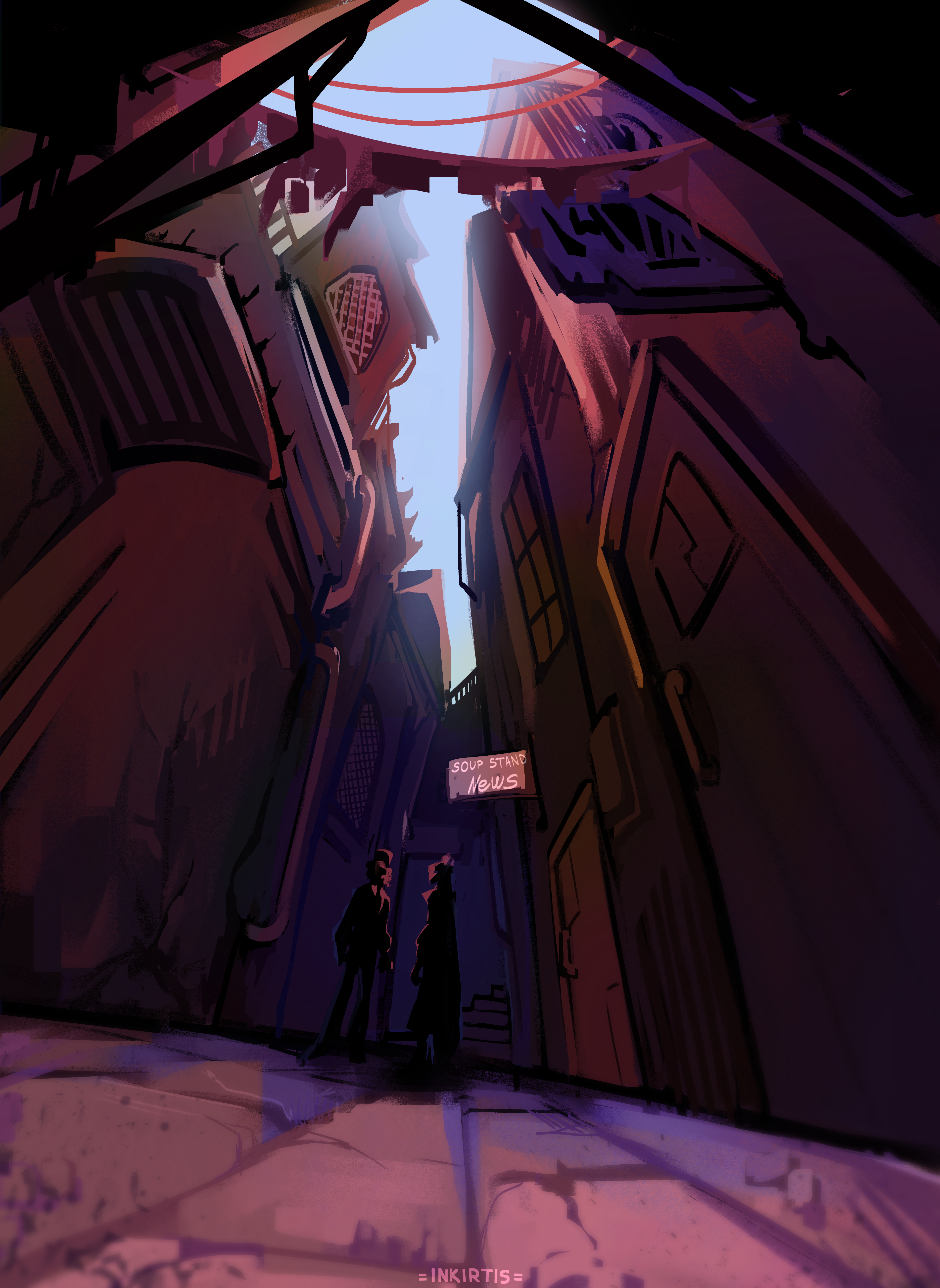
The wooden plaque above the door Jim pushes open declares it as the home of the Soup Stand News. Jim leads Ed through a small room with a printing press, an older woman stamping ink onto pages, and into the office at the back labelled Susan.
Izzy and Lucius are already there. They look at him, and Ed shakes his head. He doesn’t want to say it. He can’t say it.
“Where is he?” Lucius asks.
“Police,” Ed says, at the same time Jim says, “Bow Street.”
“Fuck,” Izzy says, with feeling. And Ed doesn’t want to hear it. He doesn’t need to hear the dread in Izzy’s voice that lingers with them from old times. They’d never been caught, never been actually accused of anything. Had always just managed to elude detection and the police cells that would lead to prison, or worse. But that never changed the fear.
“He’s rich,” Lucius says. “He’ll be fine. For a bit.”
Izzy nods in agreement. “We’ve got to get these fuckers out first.”
“He’s in fucking prison.”
Jim waves a copy of the periodical. “So let’s tell people why.”
~~~
They publish.
They publish everywhere they can. They send out delivery kids to every newsstand they can think of, and hand deliver to every acquaintance that they can think of who isn’t connected to the Corporation. Minor parliamentarians, small lordlings. Business tycoons and scientists. The ones sitting home tight, waiting for the emergency to be over, and the ones that are fighting through the cancelled trains to reach Parliament.
There are plentiful taxis for them to take. Weather or no weather, the horses need feeding and families need a roof over their head. The end of the Parliamentary sessions sees taxi drivers queueing in their droves, trying to earn a fare from those that can afford it. More than one high sided cab overturns in the weather, but their drivers have little choice.
The factories and the docks carry on, churning their smoky output into the skies. Nothing can stop the machine of industry. Safety is for those that can afford it – the libraries, the universities, the art galleries and the theatres all close immediately.
Lucius uses Stede’s Society membership to infiltrate their hastily arranged emergency meeting about the matter, and hands a copy to anyone that will take one. Lucius reports it’s better attended than they’d dared hope – Stede isn’t the only man in town whose scientific curiosity wars against his sense of self-preservation, and there’s no-one like the rich to assume they’re immune from harm, especially when they’re stuck home itchingly bored.
The periodical creates some murmurs, but after two days the Dome splutters back on, life returns to normal, and it feels like their one shot is slipping out of their fingers.
They’ve heard nothing from Stede. The newspapers call him a saboteur and hint at treason charges. Lucius has tried to enquire and been rebuffed.
Maybe he’s gone back to Mary. Maybe she’s arranged for his release, and he’s returned to the marital home.
“Don’t be fucking ridiculous, she hates his guts,” Izzy says when Ed voices that thought.
The other alternative feels no better. That he’s still being held in a cell, and not allowed any outside contact of his own choosing. That his father once again controls his every move. Ed might even prefer Stede to be free and happy elsewhere to that. At least one of them would be happy that way.
On the fifth day, Jim bursts into Ed’s apartment without knocking. They’re holding a copy of the Red Flag, and they nearly slap it down on the table in their haste, front headlines showing clearly.
And there’s a photograph there — or at least, an etching of a photograph — one of every single flight that the Corporation monitors, rockets included. There’s details of the petralune, as well, as if the editors have seen photos of how that fits together.
Ed skims the article — it talks about the proof that the Soup had published, even though it doesn’t directly reference the article or the publication. It speculates about the weather and the moonquakes.
It asks whether Corporation control of the skies has gone too far, with too little oversight.
It asks whether Stede Bonnet is a saboteur, or someone merely imprisoned because the truth is inconvenient.
And on the sixth day, all the newspapers are asking those questions.
It feels like the floodwater of a spring thaw — at first a trickle, but then imperceptibly moving towards a roar that can’t be ignored. It moves everything in its path.
When Ed leaves the house to collect his morning bread, the queue talks of little else. They want to know who else knew. They want to know if Stede will be released. They talk about him like he’s a hero, or a villain, not a man.
Ed wants to know the same. His notebook is full of comments and observations that he wants to share with Stede. His bed is empty and no longer smells of perfumes from the Indies. He’s taken to wearing the cravat as a daily reminder, and even Izzy doesn’t roll his eyes — a sign that he’s worried, too.
On the seventh day, in the evening, there’s a knock on his door. He answers it just in time to catch a swaying, exhausted Stede.
“What…? How…?”
Stede shakes his head, grips onto Ed with a fervour that he doesn’t look like he should possess, at this moment. Like he’s a dying man in the desert clinging onto the mirage of an oasis.
“Okay, okay,” Ed says, steering him into the apartment. Into his arms. Stede goes willingly, lets Ed shut the door behind them.
For a moment they stand there, not saying anything. Stede feels thin underneath his clothes, and he smells wrong, as if he’s been washed in harsh, carbolic soap instead of the fragrances that he prefers. Even his hair feels fragile.
“Zheng Yi Sao,” Stede says. “Editor of the Red Flag. They let her bail me out.”
“Why?”
Stede shakes his head. “I don’t know. She wants to meet — all of us — tomorrow. At eleven. She knows, Ed, about all of us.”
“Shit.” Ed’s head is spinning. This is big. “Okay. We need a plan.”
“Not tonight.” Stede holds him closer still. “Ed, I missed you. Every day, I wanted to speak with you.”
“They wouldn’t let us near,” Ed says. “Lucius tried.” A weak excuse. He’s been to the Moon for this man, and they’ve been less than five miles apart for a week.
“I know,” Stede says. “I know you couldn’t. They wouldn’t let me see anybody at all.”
“You scared them.”
Stede smiles into his shoulder. “With good cause, thanks to you.”
“My hero,” Ed says, and presses kisses into Stede’s hairline. Presses kisses under his ear. Finds his lips, and feels Stede lean into it. “You’re tired,” Ed says. He would like the records to state that he’s making an attempt at being gentlemanly, despite the flare of response in his body.
Stede kisses him back insistently, ruins it by yawning loudly into Ed’s mouth.
“Let me look after you,” Ed says. And he knows Stede’s body, now, knows how to touch it to soothe it and torment it at the same time. Undresses him bit by bit and lays him out on the bed. Kisses him everywhere except the place that Stede wants him to.
“I’m not feeling very sleepy, here.” Stede’s voice is distinctly bitchy, if a little thready, one hand lightly gripping Ed’s hair with the suggestion of a direction, and Ed smiles against his thigh. He sounds like Stede. His Stede.
Ed ignores all of Stede’s comments and brings himself up to kiss Stede, to feel the shape of his mouth again and again, to lower his hand to touch and move and feel Stede pant into his mouth at the contact. To tangle their legs together until it’s hard to know where he ends and Stede begins. To feel Stede’s hand on him in return.
He didn’t know if he’d ever get this again. He didn’t know if he’d touched Stede for the last time, if he’d never get to taste him again. But underneath the carbolic soap there’s the hint of the real Stede, and he’s here. There’s nothing frantic about this, just Stede breathing evenly against his cheek and both of them cresting higher and higher until the wave breaks and he groans into Stede’s shoulder and they both breathe as their muscles relax.
By the time Ed has used a washcloth on them both, Stede is snoring, mouth open, on his back. Ed climbs in next to him and pulls the cover over them both.
~~~
When Ed wakes up, the other side of the bed is empty. It’s the first time he’s slept deeply since they’ve been apart. It’s the first time he’s not lain in bed worrying about what circumstances Stede is having to endure.
He covers himself a robe, and walks out of the bedroom to find Lucius eyeing his legs.
Fuck him. If he wants to wander into Ed’s apartment without a by-your-leave, he can deal with Ed partially dressed.
Stede is reading articles as Izzy places a hard-boiled egg in front of him. He’s clearly engrossed — he waves his spoon at Izzy in a gesture of thanks, and Izzy rolls his eyes.
Stede’s probably lucky that he has just spent a week in prison with Iz not quite sure if he’s alive or dead.
He notices Ed, though, smiles at him in greeting as Ed pulls up a chair. “Any chance of one for me, Iz?” Ed asks.
Izzy flips him the bird. Izzy starts making another batch of eggs anyway. When Jim and Olu show up, he sighs, and adds two more.
Ed twines his legs around Stede’s as they make their plan of action — Zheng Yi Sao is feared. Her news conglomerate conquered the South China Sea and the ports before she bought out the Times and renamed it to the Red Flag to fit in with her fleet of newspapers.
The plan is: they have no plan. Jim and Olu have never met her — they’ve never been employed by any of the larger newspapers with the whole being blacklisted thing — and don’t know any more than is available publicly.
Stede nods. “We have the truth,” he says firmly. “We’ll be fine.”
Ed wishes he had that level of confidence. He tries to let Stede’s infiltrate his system. Lets Stede dress him appropriately for the occasion, with a silk-lined top hat and waistcoat that match.
They leave, as a group.
The first time Stede’s name is called out, they’re buying train tickets for the underground line.
Stede’s head pops around, trying to find the source. A guy — well dressed, a gentleman — gives him a thumbs up. “You’re the best!” he says, before hurrying for his train.
“How odd,” Stede says, his face pink.
It happens again, on the train. A woman in plain clothes comes and shakes his hand. Someone claps him on the back and tells Stede that he’s the talk of the factory floor.
“A crying shame,” the elderly person on the ticket booth says, on their way out. “Locked up for finding the truth.”
“Thank you,” Stede says. He looks back, twice, as they walk away.
“It’s the same thing that the papers say, mate,” Ed reminds him. “You were reading it this morning.”
“It’s different,” Stede replies. “Actually hearing that people think that. Opinion pieces are mainly there to inflate the author’s ego, after all.”
Ed lets his hand rest on the middle of Stede’s back, purportedly to guide him around a carriage in the street, but then doesn’t remove it. Stede’s got Ed. He's got all of them. Ed wants him to remember that, especially going into this meeting.
The offices of the Red Flag rise above them, magnificent even in the surroundings of wealthy Fleet Street. Newspaper people bustle in and out of offices along the road, and the taverns that are dotted around will serve good quality drinks. The carriages and cabs are pulled by smart trotting horses, matched by colour, rather than the drab feathered cobs that are seen elsewhere.
Ed lets his hand drop from Stede’s back. There’s no need to give these people more knowledge of them than is needed.
They enter, are relieved of their hats, and are directed to wait in a small meeting room with barely enough chairs for all of them.
An older woman enters. Ed’s eyes narrow — he knows her. He recognises her from somewhere.
When Zheng Yi Sao enters, he forgets about anything else. She’s dressed crisply and cleanly. She wears a dress that on paper is demure and appropriate for a modern lady, but on her gives an air of impropriety that intrigues Ed.
“Susan?”
Ed — and everyone else except Jim — turns around to look at Olu, who is staring with his mouth open.
“You’re the soup lady,” Olu says, which makes no sense.
“Why do you run the Soup when you run this?” Jim adds.
“Who’s Susan?” Stede interjects.
“Her.” Olu points at Zheng. “She’s Susan. She owns the Soup Stand. She’s the only one that has published us in the last five years.” He looks back at Zheng, a slightly complicated look on his face. “She’s nice.”
This seems to get a reaction from Zheng, and for a moment she almost looks human as she looks back at Olu. “I think you’re nice, too.”
“Zheng,” the older woman says, and it draws Zheng’s attention back to the rest of them.
“I couldn’t use the Red Flag to look into the Domes,” she said. “It’s too big. The Corporation would have noticed and brought us down. Their Government contacts would have driven us out of business. Creating the Soup Stand gave me the freedom to publish the stories I wanted to. Hire the journalists I wanted.”
“You didn’t hire us that much,” Jim mutters.
Which, fair. They wouldn’t be lamplighters if they had a regular job, Ed guesses.
“You’re not the only game in town,” Zheng says smoothly. “And I gave you what I could. Even with the Soup, we couldn’t go too far. Had to wait until the right time. Until we had the right evidence.”
“And that’s me?” Stede asks. The support on the way seems to have bolstered him, a little, and he looks assured.
“The evidence you brought to Jim and Oluwande was the start of it. The discarded camera that Tiff found outside the Corporation headquarters really blew the lid off everything.”
She looks at Ed. “I suppose you would like that back, Mr Teach? It’s an ingenious contraption.”
Ed looks at her. “S’pose you’ve already copied the design?”
Zheng smiles. “You don’t appear to have filed it with the Patent Office, as yet?”
Ed hasn’t, partly because he doesn’t want some of those on file, not yet. It’s not like anyone else is messing around with these kinds of things, or getting anywhere close. It’s the kind of shit that’s not profitable and not fashionable, and no-one else would give a flying fuck about.
Well, except Stede.
“It’s pending.” It will be, tomorrow.
Zheng clicks her fingers and a blonde, smartly dressed woman comes into the room and hands his camera to Zheng.
“In exchange,” she says, eyes focused on Ed. “I would like further information.”
“How do we know we can trust you?” Izzy asks.
She smiles at him. Sweetly. “With everything that you’ve given me so far, what choice do you have? But I would like to enter this in the spirit of co-operation, Mr Hands. Your masculine competitive jostling bores me, frankly.”
“What do you get out of it?” Ed finds himself saying. He thinks he likes her.
“This Government — this power structure — isn’t one that is eager to see me rise to the top. The chaos of the truth would be to my advantage.”
And doesn’t Ed know that. The limits of what is acceptable to achieve, if you have the wrong face. The limits of how many accolades a person can collect for themselves before they have to be brought under the heel of someone who is acceptable.
“You want to bring them down,” he says.
She smiles. “I think we’re due for a change, don’t you think?”
~~~
It’s been nearly a year, since the Moon. It feels like six days. It feels like six decades.
Zheng’s plan had worked perfectly, in the end. She’d exposed the entirety of the empire that the Corporation had built for itself. Had forced a parliamentary inquest in the City, into how it had been allowed to happen, and other countries had followed, one by one. The inquest progresses slowly, as far as Ed knows. No conclusions yet. But it’s in vogue now, to swoop on the Corporation, so the newspapers spin out every detail that is revealed like a cat playing with a mouse. No-one, not even the cat, knows whether it will bore of the mouse and release it, or end its misery.
Zheng’s even found someone who would testify that the board knew that the weather was linked to the growing mining, a fact that the newspapers have fallen over themselves to report.
Have fallen over themselves to ask Jim and Olu to report as well — their star has risen, and everyone trips over themselves to say that they always believed. They’re both bound to the Red Flag though — Zheng’s offer professionally pales in comparison to the tie that she’s formed with them personally.
Society has fallen over itself to lift Stede up as well — he was exactly the sort of hero they wanted to see. Disinherited son of a disgraced father, fighting back against the system for the common man.
Ed’s past as a common man had made him a less suitable candidate for their admiration. There are some things that Zheng’s actions haven’t changed. Society had been happy to cast him as a slightly dangerous man of mystery, once upon a time, when he’d been in favour, but outright admiration is a step too far.
Ed had watched everything unfold with bated breath. Stede had been invited to dinners and galas, had been given gifts and invited to weekends away. Stede had enjoyed it. Ed had been incidentally invited to some of these things, and he’d tagged along, and watched, as Stede had been plied with drinks, and small chocolates, and trinkets. The gossip columns had delighted to discuss who he was flirting with, and who he was paying attention to.
Stede called him jealous, when Ed tried to warn him. As if his newfound fame was a tangible object that could be taken from him like sweets are removed from a child. And Ed tried not to take it personally. Had bitten back any response that he could make, and tried not to point out that he knew what he was talking about, with this.
He knows that fame is seductive. He knows that it lures you in. He knows that it turns on you, eventually.
And when the tide had turned, it had been vicious. The whispers edged into the gossip columns edged into outright talk. Doug was held up as an example of Stede’s inadequate manhood. Ed was held up as an example of Stede’s inadequate morality. It didn’t matter that half of London’s wealthy elite were living in similar circumstances — these things only ever matter when the hounds are baying for blood.
When someone spat at Stede in the street, Ed had cracked. The invitations had dried up. The world was in uproar, and the work they did have didn’t require them to be in the City at all. There was no need for them to be at the heart of things, where things like this happened. They could just leave.
Stede’s wife had been their saviour; she and Stede had been forced into contact again throughout the whole miserable affair. Mary had pointed out that the cottage existed, and like all the property they owned was technically still Stede’s. It had lain empty since the last occupant had moved into the City along with everyone else, the building slowly falling into disrepair.
And now they’ve been here for several months, towards the edge of the Dome, and Ed can see Stede pottering in the garden, pampering the skeletal remains of the broccoli that he’s tried and failed to grow. He’s not a man who admits defeat, even if Ed secretly thinks that the caterpillars have this one.
Ed doesn’t want to be here permanently. He’ll get bored, eventually, and need the rush of City life, the same feeling as he had when he was young and foolish and thought you could hop on a boat to the other side of the world and be a success.
He supposes whether his younger self was right depends on the given definition of the word.
While Stede had absorbed the fame, Ed has been absorbing his freedom. With the stranglehold of the Corporation breaking, all its assets tied up in legal fees to defend itself, and the board members facing their own rebellions, the control they’ve held over the market is slipping. They’ve also paid out rather handsomely for several libellous allegations they made about Ed and his past.
He’s free. He can do whatever he wants. He tinkers, in his new workshop, and he watches his man garden very badly. One day he’ll get bored. Today, he has everything he could want.
When Stede comes in, he asks, “Anything interesting?” and nods at the newspaper.
“Interesting discussions about the upcoming elections. The Government is talking about forcing the Domes to reduce their intensity, to limit the use of petralune.”
The Opposition are hounding the Government throughout all of this to take action. No-one seems eager to point out that the Opposition have been the party of power several times throughout the Domes’ lifespan.
Stede glances up at the Dome above them, hmms thoughtfully.
Their cottage is just within the Dome, that still stands over them. The Corporation argue that their original purpose still stands. That regardless of why the weather had become bad, it was bad, and the Domes were needed. They fail to mention that the bad weather has increased exponentially since the Moon mining began. That they are now creating the worsening circumstances that require an increasing number of Domes. That the people who profit most from the circumstances they are exponentially worsening are themselves.
But no-one wants to argue with them, because everyone likes living in them. They make life easier. Ed and Stede have chosen to stay within its protection.
Ed has spoken to scientists who think the weather could return to its original state and rate of change within fifteen years, if the mining completely stopped and the Domes were powered down.
Instead, the Corporation has reduced the Dome power by ten per cent in several of the Cities with the biggest outcry, and congratulated themselves.
Stede comes and reads over his shoulder, although whether that’s because he’s interested or whether that gives him an excuse to drape his arms around Ed’s shoulders and drop a kiss on his cheek, Ed isn’t sure.
He’s not complaining either way; the smell of fresh earth clings to Stede these days, overlaying the colognes that he loves so much.
“People are angry,” Stede says. “I think it could be better. Things could change. The New Start Party are gaining ground.”
Ed hasn’t paid attention to them — it seems wild that an entirely new party could form, sprung from the anger of duped politicians from both sides. It seems wilder that Zheng is at the head of it. “Seems an outside chance.”
“So does going to the Moon, darling. And she has good people around her.”
“Alright, alright.” He wants to believe, when Stede says it. He has believed, and it’s paid off in ways he couldn’t imagine. And she has Izzy with her, with his steady presence and his determination, Lucius is his assistant now.
Maybe one day Ed will want to join them. Maybe one day he won't be so exhausted.
Stede smiles against him. “I love you.”
It’s not the first time he’s said it — that was a quiet afternoon, three weeks after they’d arrived home. Fucker had just dropped it over tea and cake, like he was mentioning the weather. Nothing special. Ed had dropped his Victoria sponge into the sugar bowl and stared until Stede’s nerve had broken and he’d started babbling apologies.
They’ve got better at it since then. They’ve had a lot of practice.
Ed turns his face, touches his forehead to Stede’s, closes his eyes and lets out a deep breath. Whatever the future holds, it holds this. “I know,” he says. “I know that.”