
Chapter Text
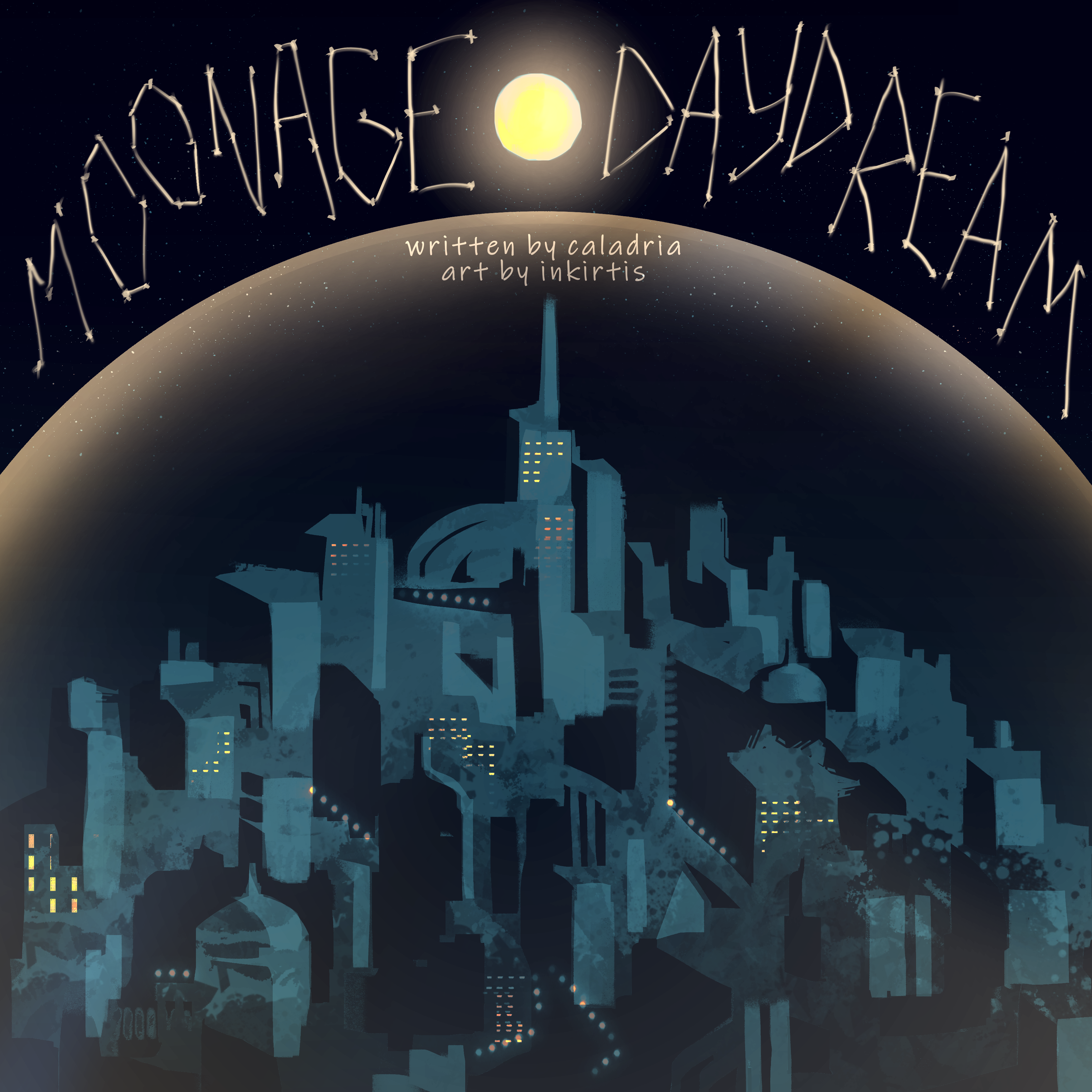
It’s early evening, and the smog lies heavy on the ground. Further down the cobbled street, Stede can see the lamplighters setting to work, small specks of light flickering on sequentially, growing nearer.
He draws his coat closer to him and clutches his bag. This is a nice area of the City — pickpockets and thieves are rare here — but his cargo is too precious to risk, and he’s more wary than he normally would be.
As he walks past the lamplighter, they tip their cap at him, revealing a shock of curly hair on top of their head. “Evening, sir,” they say.
Stede lifts his own hat in a return salutation. “Dome’s particularly vibrant tonight,” he comments.
The lamplighter looks up, leaning a slender arm against the lamppost they’re about to activate. They regard the purple shimmer of the Dome that covers the sky for a moment, and then look back at Stede.
“Don’t you think it’s getting brighter all the time, these days?” they ask idly. They have an accent from the Americas that Stede doesn’t hear much, now he’s made his home here — it’s more usual for people to emigrate from the City to there rather than the other way around.
“It’s increased in intensity by approximately thirty two per cent in the last six months,” Stede says.
A fact that preys on Stede’s mind every day. It feels like he’s in a race. It feels like he’s constantly falling behind.
The lamplighter’s gaze is fixed on him intently now. “Really?” they say, far too eagerly.
And Stede maybe shouldn’t have let slip his interest in the Dome — not to a stranger. It’s for the good of all, the Corporation says. They say their Domes will eventually be numerous enough to protect everyone from the extreme weather events that occur outside them, and they now cover every major city over several continents. The Cabinet backs them fully — half of the funding for the Domes has been government grants. The major newspapers are in agreement, and polite society follows the columnists.
There is vigorous debate as to the best use of the Domes, and of the appropriate sources of funding for them, of course. But no-one questions the concept.
“A mere observation!” he says, trying to cover his own words. Possibly more habit than real fear at this point; this isn’t polite society, with his comments filtering through layers of gossip. His words are spoken into a near-empty street containing only a person who doesn’t know his name. “I’ll not detain you further,” he says, tips his hat once more, and leaves.
He doesn’t speak to anyone else as he hurries through the streets, the cobbles becoming less even and more unkempt as he gets closer and closer to home. He could have taken a hansom cab, of course, but his funds are rather limited these days. And what he has, he directs into his work.
He clutches the package a little tighter as he enters his own street. There are plants growing through the cobbles at the side of the road here, spots of green and colour that can be treacherously slippery underfoot when it has rained.
Stede’s keys are gathered together on a metal ring, and he fumbles for the front door key to the building. Metal scrapes inside metal as he unlocks the door and enters the communal entrance. He checks the post that has been neatly arranged into a small pile on the console. Nothing for him. Some correspondence for Mr Buttons, the long-term resident of the ground floor, and a typewritten letter addressed to a Mr E Teach, the seldom-seen occupant of the first floor.
They have nodded at each other on the infrequent occasions that they pass each other on the stairs in the month since Mr Teach has moved in. But Stede has learned nothing else about him, save that he keeps odd hours and has few visitors.
He doesn’t spare a glance at the mysterious Mr Teach’s door as he climbs the stairs to his own rooms on the second floor. His own door is unlocked, and he just pushes it open.
“Success!” he announces as he walks straight through to his workroom and places the precious bag on the bench. “The glassmaker came through for us.”
Lucius looks up from his bookkeeping.
Or at least, Lucius should be working on the bookkeeping that Stede pays him to complete. Stede is fairly certain that the charcoal on his fingers is more likely to originate from Lucius’ sketchbook than from taking inventory, but he’s too invested in his new purchase to delve into that right now.
“You’re sure about this?” Lucius calls after him as Stede returns to the doorway to hang up top hat and coat before returning.
“The gentleman assured me that these lenses are to the highest specification!”
Stede had done his research. The Royal Society might not like to acknowledge that they count Stede Bonnet amongst their members, but they dutifully send out their pamphlets and findings to him in exchange for his membership fee. Much of it is of interest to him academically only — explorations of the Northwest Passage and of the Pacific are exciting in their own way, and he marvels at the botanical and faunal discoveries that explorers report and bring back — but his true love is loftier than those earthly delights.
Lucius makes a face that suggests his faith in the glassmaker is considerably less than Stede’s.
“Oh, hush, Lucius,” Stede says. It’s not that he doesn’t value the other man’s caution, but sometimes he wishes Lucius could be a little enthusiastic about Stede’s work. “It’s late. Go home.”
Lucius doesn’t need telling twice. He takes his sketches from under the inventory book and places them carefully into his satchel. “I’ll tell Pete you said hi,” he says as he hastens towards his own coat and scarf.
It leaves Stede alone in his workshop — Lucius’s desk sat by the shelves of books, and Stede’s workbench by the window, covered in diagrams and charts. He should leave this room until tomorrow. He should pour himself a brandy and sit with a book to unwind — The Unparalleled Adventures of One Hans Pfaal has been sitting by his reading chair for several days.
He loosens his cravat. He looks to the door, in the direction of the brandy. He turns away from it and opens his bag.
These lenses are the best available on the market. The glass has been made with clay stirrers, to reduce the imperfections. There are not one but two lenses, designed to counteract the chromatic issues that come with a single concave lens.
He has paid a fortune for these. He takes the eyepiece out of the bag, glass polished to precision encased in mahogany wood. It will take some time to attach it, but this is a task that can consume Stede, and he has nothing but patience for it.
He sets to work.
He takes the stairs from his workshop up to the rooftop garden that is the real reason he’s taken these rooms. There are plants, certainly, and there’s an element of calm up here, completely detached from the bustling city below. But more importantly, he’s above the lights of the gas lamps in the street, and he’s above the candlelight peeking through windows.
His pride and joy sits here on a stand — a telescope. Parts of it have been built by his own hand, parts constructed by craftsmen, but entirely his design. The eyepiece currently attached is worthless, giving Stede nothing new, not with the Dome in the way of the heavens. He carefully detaches it.
It takes time, and it takes precision. The misalignment of even a degree or two will mean that everything is ruined. He has to check the glassmaker's work, again and again, to be certain no mistakes have been made and no impurities have made their way into the glass, and then finally, he can point his telescope at the heavens and observe.
~~~
Lucius finds him in the morning, still staring through the telescope despondently.
“Morning, Stede,” he says.
“No, it isn’t.” It’s the furthest thing from. He’d been so sure that this was it. That this is what was going to help. He’d seen papers, written before the Dome, before astronomy had fallen out of fashion as a science. They all exulted the methods. They all claimed that this is what would sharpen the skies to the serious observer.
It hasn’t. The haze of the Dome dominates his view even more clearly through the telescope than it does from the naked eye. The moon is obscured, and the stars are barely visible. He should be able to see Saturn and her rings, but there is nothing. Perhaps this is why the scientists have gone quiet about this. Science doesn’t tend to advertise its failures, only its successes.
“Do you mind putting the ‘scope down for a sec?” Lucius asks. He sounds kind. Stede must look terrible.
“I can’t hear you,” Stede says. If he doesn’t put the telescope down, he doesn’t have to admit defeat. Maybe he can change something about it. Maybe this is about Stede’s failure, not failure of the concept.
“Okay, I’ll just…” Lucius says, and reaches for Stede. “Let’s just take you away from that for a second. One, two… three.”
Stede finds himself pulled back to a more upright sitting position, every joint screaming with how hunched he’s held himself all night.
“Long night?” Lucius asks. Stede didn’t think Lucius had it in him to be this gentle.
“I don’t know,” Stede says. He doesn’t know anything right now. All of his hard work, coming to nothing. He had dreams, once. He was going to be an astronomer. He was going to discover comets, and new stars. He was going to chart the moon to a degree that no-one had ever aspired to, mapping every crater and Lunar mare. He’d spent a childhood staring up at it — an unexplored world that man had never touched — and dreamed of its secrets.
And then as soon as he'd found it within his circumstances to pursue astronomy properly, and to finally have the fine details within his grasp, the chance was taken away from him. The Domes had started over the City, but they had spread so rapidly as soon as they were declared a success. And outside the Domes the inclement weather makes studying the heavens near-impossible. There’s no way to find a clear sky these days.
But he doesn’t know which way to turn, now. The lens was his last shot. And it’s fallen short. “Lucius,” he says, heavily. “I think it’s done.”
Lucius pats his arm a little helplessly. “Honestly, I don’t know what to say. Shall we get some breakfast?”
Stede looks at him.
Lucius shrugs. “Works for regular breakups. I’m great at them.”
Stede leaves his telescope. His failure. He follows Lucius downstairs, through the workroom, through the lounge, into the kitchen. He sits at the table as Lucius makes eggs on the cast iron stove for him — he’d clearly lit it before finding Stede. Stede knows how to cook — the housekeeper provides some meals, but not all — but Lucius moves around the kitchen as if he’s used to it.
It’s not what Stede would expect. It’s not the impression that Lucius gives. He knows, vaguely, that Lucius lives with his partner. And that there are other men. But he doesn’t know how Lucius knows how to cook.
“Pete’s the real chef,” Lucius says, when Stede compliments him on the eggs. “But he likes to know I can survive when he’s out of town, or busy. And it was sweet of him to teach me.” There’s a fondness in his voice that Stede hasn’t heard before — it makes him envious, desperately, of what Lucius clearly has. The certainty. The security.
Stede has a wife who graces polite society without his presence, and two children who have more-or-less forgotten what he looks like. And, in private, call another — more worthy — man papa. Until this morning he would have said that his work replaced any need for companionship. Until this morning he would have said that his work, at least, would not let him down.
Now he has nothing. And nowhere to go with it.
“Are there any other avenues you could explore?” Lucius asks. “There must be a way around it.”
“I don’t know,” Stede says. He doesn't know anything any more. “The scientific discourse agrees that a refractive telescope is the best way to view objects like the moon, but astronomy has basically ground to a halt as a discipline now that the Domes exist.”
“So there’s nowhere else to go?”
Stede shakes his head. “The other type of telescope is reflective. I don’t know if they would solve our problems - but they use mirrors and I don’t know who could create mirrors to the degree of accuracy that we’d need.”
“Maybe an engineer?” Lucius suggests. “Because what do you make mirrors out of, metal? Zeppelin companies work with that.”
Stede shakes his head. “It feels like a risk.” What they’re doing isn’t illegal in any way, or even explicitly disapproved of. But the thought of asking a company, especially one that will almost certainly have government or Corporation contracts, and drawing attention to his celestial aspirations, sends a spike of anxiety through him. “I suppose who we need is more like an inventor.”
“There aren’t many of those around, these days,” Lucius reminds him. Any individual with an ounce of talent is getting swept up by one of the larger commercial outlets and given a stipend. The smaller outfits that had previously flourished are few and far between.
Inventors used to be plentiful; mavericks who created daring contraptions, working alone or in small groups. There were those who patented their concepts and sold them on, and those who were more spectacular, creating shows of astounding machines to draw in audiences.
“There are still a few, surely,” Stede says. “Hornigold—“
“Dead.”
“Bellamy?”
“Works for ZepCorp.”
“Blackbeard?”
Lucius pauses. “No-one’s heard from him for years.”
“He did some remarkable work with camera photography,” Stede says carefully, because Lucius' words have sparked something. Not a full thought. Just the beginnings of one, germinating. Sending its first tendril through the soil to seek the light.
“How would you even get in contact with him?”
“He did some remarkable work with camera photography, Lucius!” Stede repeats, because the idea is sprouting now, every part of it straining to be seen.
And Stede is up, and back into his workshop. “Very intrinsic mirror work!”
He’s running his finger across the Royal Society proceedings from several years ago. Picks one up, thumbs through the contents. Puts its back. Picks up several more and repeats this until he finds what he wants. Finds the page for A presentation on a novel mirror organisation for the improvement of poor light photography; Blackbeard et. al.
There’s a contact address at the bottom, as is standard. Sometimes it’s a university address. Sometimes it’s a laboratory, or a home address. This one is a private letter box at a district post office, care of a Mr I Hands.
Stede supposes that even famous inventors have real names.
“That’s seven years old,” Lucius says doubtfully. He’s followed Stede into the workshop with the air of resignation that he wears when he thinks Stede has lost whatever marbles he might still have possession of. “It might not even still be active.”
“Then the letter will be returned,” Stede says, somewhat impatiently. “At least we’ll know.”
Lucius continuously rolls his eyes as Stede dictates the letter to him. Stede is never sure whether Lucius thinks that Stede doesn’t notice, or that Stede doesn’t care. The reality is neither; Lucius’ doubt cuts through him with a wave of uncertainty. In truth, though, he has no choice. All other options appear to be a dead end. Neither of them can think of an alternate plan. If this fails miserably — and Stede is willing to admit to himself if not to Lucius that it may — then they are no worse off than they are right now.
He sends Lucius home after that, with direction to go via the closest post box that will collect today. There’s very little they can do now except wait.
Without his work — without anything to do — Stede is lost. It’s only midmorning. He wanders downstairs to collect the morning newspaper.
“Morning, Mr Bonnet,” Mr Teach says. He’s clearly on his way out, hat and cloak in place and with outdoor shoes, and his long hair tied up politely. His greying beard is still long and wild, though.
“Mr Teach,” Stede says politely, suddenly wishing that he’d thought to wash up and change before venturing out of his front door.
“Are you well?” Mr Teach enquires.
Stede is not, really, but Mr Teach would have no interest in the vagaries of his work or the disappointments therein, so he replies with a cheery, “Quite well, thank you!” He supposes that his dishevelled appearance may suggest otherwise.
“Any news?” Mr Teach asks.
Stede looks at him blankly until Mr Teach nods at the newspaper.
“Oh, I believe the world is going to hell in a handbasket once again,” he says wryly, and Mr Teach gives a laugh at that. Most people laugh at Stede. This feels more like he’s laughing with Stede, mouth turned up pleasingly and his full attention unwavering.
They part then — Mr Teach checks his pocketwatch, realises he is late for his appointment, and makes his excuses — but it makes Stede feel a little lighter as he returns to his rooms. A successful social interaction, with the added benefit of his new neighbour not being completely disinclined towards him. The previous occupant of those rooms had sighed as they'd passed in the hall after every time Stede had paced the floor at three am, and pushed letters of complaint through his door on a not-infrequent basis.
Stede spends the next few days reading his book. He takes the air, with a walk around the local park. He checks the console for post at least three times a day, lest one of the deliveries appear without him noticing.
He gives Lucius the week off, after assuring him that his pay would be unchanged. Isn’t sure whether to be annoyed, relieved, or touched that Lucius finds reasons to pop his head through the door every other day. He doesn’t have much else in the way of human contact.
He reads his book and drinks his brandy, because there is little else to do.
It takes six days for a letter to appear, handwritten in a strong, solid, script that evokes the strength that Stede associates with the rumour of Blackbeard. Maybe a little more straightforward than he would expect.
He clutches it to his breast in excitement.
“A much-awaited letter?” Mr Teach asks. He’s just returned to the house, and he stands holding his dry, unused, umbrella as he asks. “Someone close?”
“Oh no,” Stede says. He couldn’t think who would evoke such feeling in his personal life. “Professional joy. Or at least, I hope. Perhaps a collaboration.”
Ed nods and looks away, placing his umbrella in the stand, and perhaps it’s rude to open it in front of him, but Stede does so anyway. The fizzing anticipation threatens to burst out of him in all the wrong places, like one of those carbonated drinks that the kids of today drink.
His face falls as his heart sinks into his shoes. The letter is short. Brutal. Definite. A no. Blackbeard doesn’t consort with unknowns. He is offended that Stede has asked.
“Bad news?” Ed asks. His eyes are very brown and very soft as they look at Stede.
“I’m afraid it’s a bust,” Stede says. He gives an expansive shrug, trying to convey what can you do? rather than the sinking disappointment that his heart feels.
Ed’s eyes fix sympathetically on the letter. “Who did you say you were corresponding with?” he asks.
“Oh, I didn’t.” He doesn’t think he did, anyway. “I was asking a favour from an inventor - Blackbeard.”
“Blackbeard?” Ed says in an odd tone of voice that Stede cannot decipher.
Stede startles. “You’ve heard of him?” Within certain circles inventors can be really quite famous, but few break out into public knowledge.
Ed doesn’t smile. “Oh, yeah. Heard all about him. You looking for something flashy?”
And Ed must have heard about Blackbeard, because that’s what he’s most famous for. Spectacular contraptions that defy logic and amaze the crowds that flock to see them. The most showmanlike of all the inventors.
“Oh, no,” Stede says. “I was requesting some very specific mirrors that I thought he could help me with.” Now Ed has mentioned it, he wonders if that’s part of why Blackbeard has declined. It wouldn’t be the first time Stede has achieved the feat of being both too outlandish and too boring for words.
Ed looks at him quizzically. “Not really known for the mirrors, mate.”
“Oh no, you’re wrong!” Stede says. He launches into an explanation of the presentation that Blackbeard had given to the Royal Society, the intricacies of the camera that could take photographs in the near-dark. He’d been fascinated with it at the time — he hadn’t dared to escape his father’s grasp to attend — but he’d hungrily devoured the proceedings afterwards, fascinated by the genius of the idea.
“…I’ve got no idea why we never heard anything about it again,” he finishes. It had been such a fascinating idea.
“Funding,” Ed says. “ No-one wanted to pursue it.” Then adds, “At least, that’s what I heard.” He shrugs. “What do you need mirrors for?”
Stede hesitates, just for a moment. It wasn’t the done thing, to admit a fascination with the skies. Not these days. It had fallen out of fashion. And to speak now would not be an anonymous slip up with a lamplighter that would never come back to haunt him. Ed is his neighbour. And Stede knows nothing about him.
Nothing except that he’s showing an enthusiasm for what Stede says that seems more than just polite. And that he clearly has an interest in inventions, and in science.
Stede can’t always tell the difference between someone feigning polite interest and genuine curiosity. Doesn’t always notice when he’s being tolerated instead of welcomed. Has never managed to distinguish those two.
But he’s never been able to extinguish hope, either.
“A telescope,” he says. “I want to build a telescope.”
“Don’t you need a glassworker for that?”
Stede shakes his head. “I’ve tried that. It doesn’t work. The Dome, you see. I want to collect light through mirrors.”
Ed looks at him. “You have a telescope?”
Stede should hesitate. Stede should interrogate the giddiness in his mind, but instead he says, “Can you keep a secret?”
They climb the stairs together, not looking at each other but accompanied by an air of anticipation making the air crackle. Ed doesn’t even glance at his own lodgings as they pass it.
Stede opens his own door and ushers Ed inside. Leads the way silently through to his workshop, and hears Ed’s steps on the stairs as he follows behind him.
He opens the door to the roof garden, and hears a gasp from behind him.
“Fuck off,” says Ed, in an awed tone. He nearly pushes past Stede in his eagerness to get to the telescope. “You made this?”
“All my own design,” Stede says. He’s feeling pride, with how Ed is running his fingers over the joints. “Some of the work I commissioned from craftspeople.”
“Fucking mental. And you did this just because you wanted to?”
“Just for fun!” Stede says, though ‘fun’ doesn’t really encompass the depth of what drives him.
“And you want to make one with mirrors?” It’s full daylight but that doesn’t stop Ed from taking the seat in front of the telescope and squinting through it, even if he’s careful to avoid the sun. It sends a thrill down Stede’s spine. No-one else has ever sat there. No-one else has ever cared to sit there.
“It would gather light differently, bend it differently. I’m hoping it would allow me to see past the Dome to fully experience the heavens.”
“And the mirrors reflect all of the light into your eye, right?”
“Yes!”
“Like a lighthouse reflecting the lamp out to sea?”
“Exactly!”
Ed gets it. Ed is beaming at him as brightly as the sun, warming Stede with his approval.
“So how big will you need your new telescope to be?” Ed asks.
“Seven feet,” Stede replies promptly. “Six point two inch reflecting mirror.”
“With the right curvature?” Ed asks, and Stede nods.
“It has to be precise,” he says. “Which is why I was hoping that Blackbeard — Mr Hands — would help.”
“Izzy’s not Blackbeard,” Ed says absently.
“He’s not?” Stede asks, startled.
“No, uh, I’m Blackbeard.”
Stede stares. Thinks about what he knows about Blackbeard. The… the beard. It’s grey, now. He’s seen some artist’s impressions as well, in the scientific section of the newspaper. Long, flowing, hair. Tall. Dark clothing.
Oh.
Ed is Blackbeard.
Ed grins at him, giddily. “Wanna build a telescope?
***
Ed’s workshop is...
It’s magnificent. There’s no other word for it. It’s exactly how Stede imagined an inventor's workshop to be. It’s full. There are machines that he doesn’t understand. There are things on every work surface, some of them ticking like a metronome, or wound tightly and ready to be set off. There are detached chimneys lined up in a row on the wall, ready to be used. There are pieces on the floor as well; metal plates shaped in ways that don’t seem to make any sense, and what Stede thinks he recognises as steam engines everywhere --- smaller ones on the table and larger ones underneath.
The only light comes from a single, solitary, window --- this room is a carbon copy of Stede’s own workroom in shape, only lacking stairs.
Ed hastily heads to the grate to light the fire. “Wasn’t expecting visitors,” he says, as the fire catches and starts to spread through the coals. “Still getting the place sorted.”
Stede wants to touch everything. So many things all at the same time. It’s a workshop that Stede could only dream of.
There are sketches, as well, on every worksurface. Diagrams labelled in the sprawling, excited handwriting of someone who is trying to memorialise thoughts at the same speed that their brain produces them. Nothing like the solid handwriting of Mr I Hands. Letters that get smaller and smaller as the thoughts become too big for the space that have been originally assigned to them; some with arrows to free spaces elsewhere so they could take full form.
Stede had completed the Grand Tour as part of his honeymoon and had visited the preserved workshop of Signor da Vinci in Florence; he had mourned the thought, then, that he would never walk the Earth at the same time as such genius.
Maybe he’d been wrong.
Ed has stood up from the grate, poker in hand, and is looking at Stede in a way that in any other man Stede would describe as nervous.
“It’s beautiful,” he says, and Ed’s face breaks out into a grin.
He gestures Stede over to a workbench, on which stands a camera, front panel of wood folded down to reveal the lens. Photography isn’t Stede’s strongest point, but the wooden box looks small — barely six inches across and briefcase-shaped. He thinks he recognises it from the diagrams in the scientific paper, though.
“This is what you presented to the Royal Society?” he asks.
“Long time ago, mate,” Ed says, and for a moment a shadow passes over his face. “Old news. But I reckon if you want lenses, then this is a good start.” He has a tiny screwdriver in his hand and he’s dismantling the camera as he talks, removing the delicate insides from the rich mahogany casing. He hands Stede a small mirror, and nods to the microscope.
The gaslight is steady as Stede focuses the scope, adjusting the viewing piece to his own vision.
“It’s perfect,” he says.
“Not quite,” Ed replies. “Needed a bit of finesse, but we were on a deadline with that one, and after that we didn’t have the funding to try again.”
Stede looks at Ed, who shrugs, and adds, “Gotta go where the funding is if you wanna eat next week. At least that’s what Iz’ll tell you.”
“Mr Hands?” Stede queries.
“Izzy. Handles all the day-to-day shit. The schedules. The funding.”
“The correspondence?” Stede asks with an admirable restraint in venom.
“He’s meant to pass anything on that I might be interested in.”
“I suppose he thought my proposal sadly lacking.”
“Your thing is so fucking weird, man, he’d never appreciate it,” Ed says vehemently, frustration bleeding into his voice clearly. “You just want to look into the sky? See it better? No-one’s doing that any more. No-one thinks about anything above their own eyeline. Even the Zeppelins are still running with the same design they were twenty years ago, everyone just fucking tweaking around the edges. And he’s the same as them. No imagination to see anything different.”
“Whereas I suffer from a surfeit of the same,” Stede says wryly. It’s not the first time he’s been told his mind is too wild.
“I like it,” Ed says immediately. “It’s different.”
It makes something warm fizz inside Stede’s chest that he doesn't recognise.